Understanding Proteins: The Building Blocks of Life
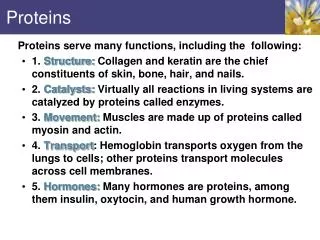
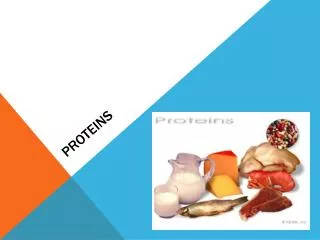
Proteins are essential macromolecules that play critical roles in the body. They act as enzymes, transport molecules, antibodies, and hormones, facilitating biochemical reactions and cellular communication. The structure of proteins is determined by their amino acid sequences, which fold into intricate shapes. These shapes dictate their functions; when proteins denature, they lose their ability to function effectively. This concise guide explores the importance of proteins, their structural levels, and the genetic basis behind protein synthesis, leading to implications in health and disease.

Understanding Proteins: The Building Blocks of Life
E N D
Presentation Transcript
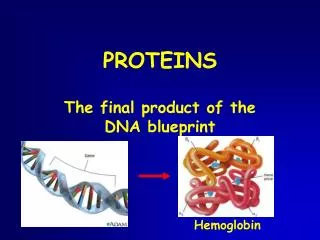
PROTEINS The final product of the DNA blueprint Hemoglobin
Why are proteins important? “When the body has something it needs to do, it is a protein that does it” http://www.rothamsted.ac.uk/notebook/courses/guide/prot.htm Antibodies – fight disease
Why are proteins important? “When the body has something it needs to do, it is a protein that does it” http://www.rothamsted.ac.uk/notebook/courses/guide/prot.htm Receptors – part of cell membrane, recognize other proteins and inform the cell (“The Door Bell”)
Why are proteins important? “When the body has something it needs to do, it is a protein that does it” http://www.rothamsted.ac.uk/notebook/courses/guide/prot.htm Enzyme that digests insulin Enzymes – assemble or digest
Why are proteins important? “When the body has something it needs to do, it is a protein that does it” http://www.rothamsted.ac.uk/notebook/courses/guide/prot.htm Neurotransmitters Neurotransmitters and hormones – trigger the receptor (“finger on the doorbell”)
Why are proteins important? Channels and pores – holes in the cell membrane
What determines the role or function of a protein? Shape – click for examples
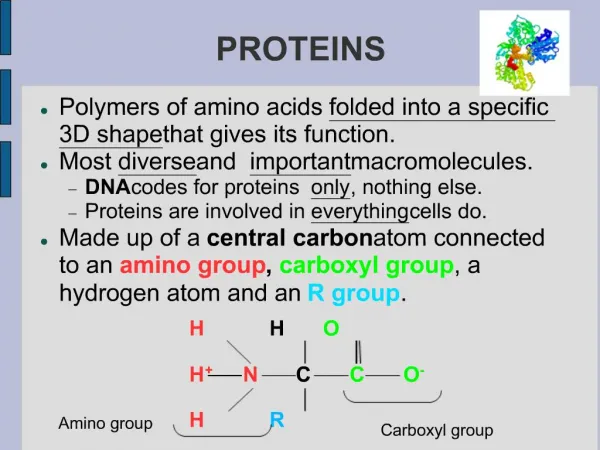
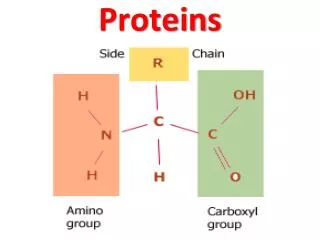
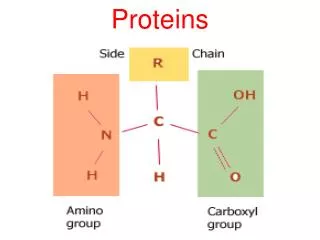
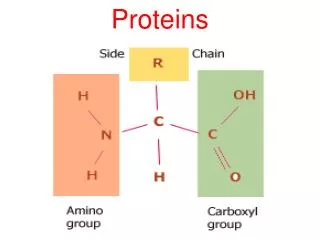
Amino Group Acid Group What determines the shape of a protein? Amino acids are building blocks of proteins
What determines the shape of a protein? 20 different amino acids each with their own size, shape, and charge
What determines the shape of a protein? Amino acids are connected by peptide bonds
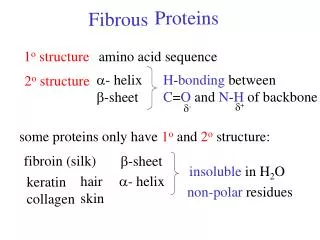
Four levels of structure Primary Structure – Sequence of amino acids.
Four levels of structure Secondary Structure – some chains form an alpha helix (coil) or a beta sheet (accordion).
Four levels of structure Tertiary Structure – How all of the helices and sheets fold together.
Four levels of structure Quaternary Structure – some proteins are made of more than one subunit.
What is denaturing? Denaturing – Losing shape. Proteins that have lost their shape can’t function correctly. What can cause a protein to denature? VIDEO
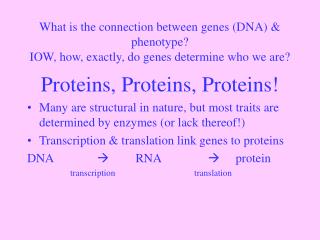
How does the body know how to make proteins? • DNA sequence. • If nucleotide order is changed: • - sequence of amino acids is changed. • - Shape of protein is different. • - Protein loses function. Cystic Fibrosis Video – “Cracking the Code” Chapter 9 – it’s in the DVD drive ;)
Genetic Testing Video CLICK HERE - http://topics.nytimes.com/top/news/national/series/dnaage/index.html - WATCH “When a DNA Test Shows a Lethal Fate”