
Exploration and Use of Fossil Fuels: A Comprehensive Guide
E N D
Presentation Transcript
Fossil Fuels Resource Use Cycle
I. Resource Use Cycle Formation and Concentration Disposal or Recycle Location and Identification Use Mining and Refining Production
II. Cycle of Fossil Fuels • General Questions • Why is oil more useable than other fossil fuels? • Fairly easily stored, transported and consumed. • Describe the relationship between petroleum, crude oil and natural gas. • Petroleum exists in the earth in two forms - crude oil (liquid) and natural gas (vapor). • Why is natural gas such a desirable fuel? • It has excellent fuel qualities, burns cleaner and produces practically no harmful by-products. • What determines the quality and usefulness of coal as a fuel? • The energy content. The higher the proportion of carbon to moisture, the higher the energy content.
II. Cycle of Fossil Fuels • Formation and Concentration • How is oil formed? • Crude oil is a product of the decay of organic plant and animal matter. Most scientists believe the material settled to the bottom of ancient seas. • Describe how petroleum collects in traps. • After formation, petroleum migrates into porous rock, until it became trapped between impermeable layers. This is a result of folding, faulting or deformation of the earth’s crust.
Formation and Concentration • Petroleum (crude oil [liquid] and natural gas [vapor]) formed by the compression, decay and heating of organic matter. • Found in source beds where oil’s migration through permeable rocks is stopped by impermeable rocks.
II. Cycle of Fossil Fuels • Formation and Concentration 7. How is natural gas formed? • Natural gas is a by-product of the formation of oil. 8. How is coal formed? • Plant matter becomes fossilized over time, compressed between layers of sedimentary rock. Coal accumulates in ancients swamps and marshes where little oxygen is present.
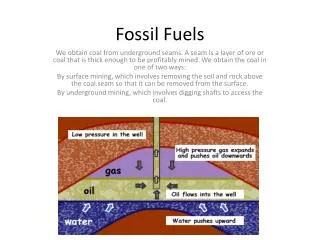
II. Cycle of Fossil Fuels • Location and Identification • What do geologists look for when exploring locations to mine for new oil deposits? • Source beds of shales or limestones that originally contained organic remains • porous and permeable sandstones or limestones that later became reservoir beds • traps that sealed off reservoir beds and held oil and gas in place. • Where are coal deposits found in the United States? • Coal has been found in most of the U.S. 1/8th of the country lies over coal beds. Eastern coals occur more in continuous seams, whereas western deposits are more isolated and less predictable.
Location and Identification • Petroleum located by finding source beds, permeable rocks, and/or traps. • Traps hold oil (see red areas below) due to:- trapping within impermeable rocks- thinning permeable rock within impermeable rocks
II. Cycle of Fossil Fuels • Mining and Refining • Explain how crude oil is refined using the process of distillation. • Crude oil is separated on the basis of different boiling points for different substances. This is done by processes of heating, evaporating, cooling and condensing. • List some types and amounts of products yielded from the refining of crude oil. • Crude oil can be distilled into gasolines, alcohols, waxes, kerosine, lubricants, asphalt, additives, oils etc.
Mining and Refining • Petroleum extracted (mined) using pumps, offshore drills, “Christmas trees” (for natural gas), etc. • Refining crude oil involves distillation (often in a fractionating tower) to separate out a host of products, including: waxes, keosine, lubricants, asphalt, gasoline, etc.
II. Cycle of Fossil Fuels • Production and Use • Equation for the burning of oil to obtain energy. • Oil + oxygen (O2) CO2 + H2O + heat energy + waste • Wastes consist of unburned hydrocarbons, carbon monoxide, nitrogen oxides and sulfur gases. • Equation for the burning of natural gas to obtain energy. • Natural gas + oxygen (O2) CO2 + H2O + heat energy • Almost no wastes are formed. • Equation for the burning of coal to obtain energy. • Coal (C) + oxygen (O2) CO2 + heat energy + waste • Wastes consist of sulfur dioxide, nitrogen oxides, carbon monoxide, soot and ash.
Production • Production of refined petroleum energy products often requires no more than distribution (via truck, boat, train, or other means) and storage.
Use • The chemical energy in petroleum products is released through burning.