Understanding Protein Structures: Monomers, Polymers, and Their Functions
This guide explores the fundamental concepts of protein structure, including the role of amino acids as monomers, the formation of polypeptides, and the complexities of primary, secondary, tertiary, and quaternary structures. We highlight the significance of R groups in determining the unique properties and functions of various proteins, such as enzymes and transport proteins. Additionally, we examine the relationships between structure and function, emphasizing how even slight changes in amino acid sequences can drastically affect protein behavior.

Understanding Protein Structures: Monomers, Polymers, and Their Functions
E N D
Presentation Transcript
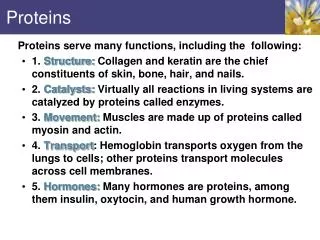
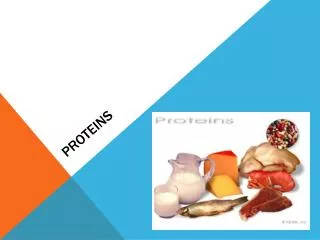
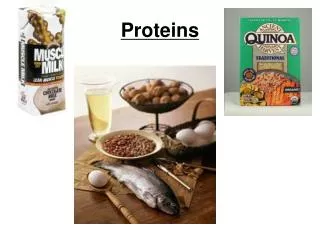
H2O Proteins • Structure: • Elements: C, H, O, N • monomer =amino acids • 20 different • polymer =polypeptide • one or more polypeptide chains folded & bonded together • large & complex • complex 3-D shape hemoglobin growthhormones Rubisco
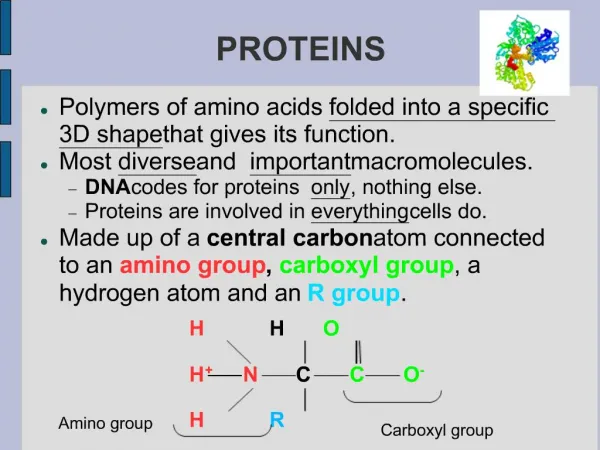
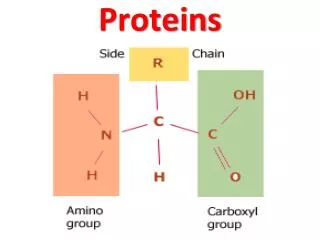
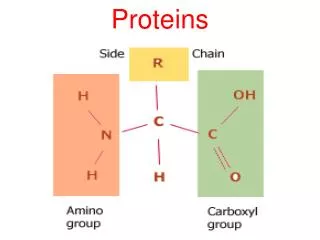
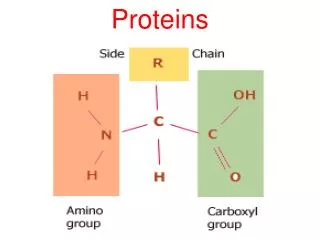
H O | —C— | H || C—OH —N— H Amino acids • Structure • central carbon • amino group • carboxyl group (acid) • R group (side chain) • variable • different for each aa • Results in unique chemical properties • like 20 different letters of an alphabet • can make many words (proteins) R
Effect of different R groups: Nonpolar amino acids • nonpolar & hydrophobic
Effect of different R groups: Polar amino acids • polar or charged & hydrophilic
H+ donors Ionizing in cellular waters
Sulfur containing amino acids • Formdisulfide bridges • covalent cross links betweens sulfhydryls • stabilizes 3-D structure H-S – S-H You wonderedwhy permssmell like rotten eggs?
H2O peptidebond Building proteins • Peptide bonds • covalent bond between NH2 (amine) of one aa& COOH (carboxyl) of another • C–N bond dehydration synthesis
1. Primary Structure – aa sequence determined by gene (DNA) 4 Classes of Protein Structure Phenylalanine • **slight change in sequence can affect protein’s structure & its function just one aa change can make all the difference!**
2. Secondary Structure – folding due to interactions between adjacent (local) aa’sa. Alpha (α) Helix b. Pleated Sheet
3. Tertiary Structure • Overall primary and secondary structure • Hydrophobic interactions • H-bonds • Disulfide bridges • Ionic bonds between opposite charges
4. Quarternary Structure – more than one polypeptide bonded together **Increased complexity = increased stability!**
Form determines function!!! Protein structure (review) R groups hydrophobic interactions disulfide bridges (H & ionic bonds) 3° multiple polypeptides hydrophobic interactions 1° amino acid sequence peptide bonds 4° 2° determinedby DNA R groups H bonds
Conjugated Proteins • Protein backbone with nonprotein group attached • Chromoprotein – pigment molecule attachedEx: Hemoglobin • “Glyco” & “Lipo”Proteins – in cell membrane; carb or lipid attached – used in cell identity • Nucleoproteins – proteins wrapped in DNAEx: histones (in chromosomes)
The Many Functions of Proteins • Enzymatic • Structural • Transport • Receptor • Signalling • Defense • Movement (contractile) • Storage