Diodes and LEDs
This discussion explores diodes and light-emitting diodes (LEDs), focusing on their semiconductor properties. By adding small amounts of boron or gallium to silicon, we create p-type semiconductors with holes (missing electrons), while phosphorus or arsenic introduces n-type semiconductors with extra electrons. Learn how these designs lead to the functioning of diodes and the operation of LEDs. Resources are provided for deeper insights into semiconductor technology and practical applications.

Diodes and LEDs
E N D
Presentation Transcript
Diodes and LEDs Discussion D8.1 Kerns & Irwin Sections 10-1 -- 10-5, 10-10
Covalent bonds -- Insulator http://electronics.howstuffworks.com/diode1.htm
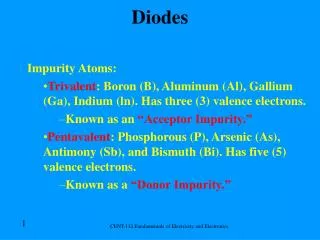
Semiconductors Adding a very small amount of B or Ga to Si makes a p-type semi-conductor with a missing electron (a hole) Adding a very small amount of P or As to Si makes an n-type semi-conductor with an extra electron
Diodes + - http://www.mtmi.vu.lt/pfk/funkc_dariniai/diod/index.html
Light Emmitting DiodeLED hn + - http://electronics.howstuffworks.com/led1.htm
Turning on an LED This is what we use in Lab