Forecasting Electricity Demand Using Demand Equations
Learn to specify demand equations, address identification problems, calculate elasticities, and forecast demand using regression models. Understand how to apply elasticities and forecasts to react to changes.

Forecasting Electricity Demand Using Demand Equations
E N D
Presentation Transcript
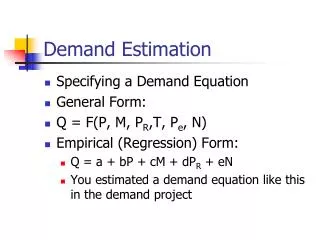
Demand Estimation • Specifying a Demand Equation • General Form: • Q = F(P, M, PR,T, Pe, N) • Empirical (Regression) Form: • Q = a + bP + cM + dPR + eN • You estimated a demand equation like this in the demand project
The Identification Problem • Estimate Q = a + bP + cM + dPR + eN • If P and Q are determined by supply and demand, how do you know that you are estimating a demand relationship? • Answer: You don’t! • If you have not estimated a demand relationship, you have an identification problem. • Warning signs: • Coefficient on price (b) is positive • Coefficient on price (b) is not statistically significant
Solution to Identification Problem • Use a technique called 2-stage Least Squares • Specify Demand and Supply Equations • Qd = a + bP + cM + dPR + eN • Qs = f + gP +hPI • Run a 2-stage least squares program • When is Identification not a problem? • Data are for a single firm setting it’s own price • Price not set by market (regulated prices) • Electricity prices are regulated by the states • Identification not a problem for demand project
Calculating Elasticities for estimated demand equations • Linear equation – demand project • Q = a + bP + cM + dPR + eN • E = b(P/Q) = (ΔQ/ΔP)(P/Q) • EM = c(M/Q); EPR = d(PR/Q) • Log-linear equation – constant elasticity • Ln(Q) = g + h(lnP) + j(lnM) + k(lnPR) • Coefficients (h, j, k) are elasticities • No calculation needed
Calculate elasticities at the sample means • Milkwh= 10800 – 3581(Pkwh) + 0.004(Pop) + 2252(PGas) • Elasticity = (coeff.)(value/Milkwh) • Sample Means: Milkwh=25365 Pkwh=9.0 Pop=5,756,577 PGas=11.4 • E = -3581(9.0/25365) = -1.27 • Epop = 0.004(5,756,577/25365) = 0.91 • Epgas= 2252(11.4/25365) = 1.01
Exercise: Elasticities • Milkwh= 10800 – 3581(Pkwh) + 0.004(Pop) + 2252(PGas) • Milkwh=38,526 Pkwh=6.92 Pgas=10.6 Pop=5,900,962 • Elasticity = (coeff.)(value/Milkwh) • Calculate electricity demand elasticities with respect to Pkwh, Pop, & Pgas
Forecasting Demand • Using Elasticities • Multiply elasticities by projected % changes in explanatory variables • Add the results to get projected % change in demand • Using linear regression equation • Multiply coefficients by projected values for explanatory variables in future period • Add results and intercept to get forecast of demand
Forecasting with elasticities • Estimate a log-linear equation • LMilkwh = 0.04 – 0.92(LPkwh) + 1.0(LPop) + 0.4(LPgas) – 0.4(Linc) • Get projected % changes • Pkwh:10% Pop:1% Pgas:20% Inc:2% • Calculate the projected % change in Milkwh • -0.92(10%)+1.0(1%)+0.4(20%)-0.4(2%) = -1% • Do not use the intercept!It doesn’t change. • Suppose Pgas goes down by 20%, not up?
Exercise: Forecasting with linear demand • Estimate a linear demand equation • Milkwh= 10800 – 3581(Pkwh) + 0.004(Pop) + 2252(PGas) • Get forecasts of explanatory variables • Pkwh=10 Pop=20,000,000 Pgas=10 • Calculate a Forecast for Milkwh • Substitute forecast values for explanatory variables and do the arithmatic