Download

1 / 19
190 likes | 301 Vues
Explore the transformative period of the Renaissance and the First Global Age, beginning in Italy and fostering humanism, the Protestant Reformation, and the Scientific Revolution. Key figures include Leonardo da Vinci and Michelangelo. Learn about the Age of Exploration, driven by mercantilism and technological advancements. Discover the impact of the Columbian Exchange and the Triangular Trade on societies. Understand the political changes wrought by Enlightenment thinkers like Locke and Rousseau, shaping modern governance. This overview covers the dynamic shifts in art, science, and society from 2010 to 2014.

E N D
Renaissance & First Global Age Review 3 Practice Questions come from 2010-2014
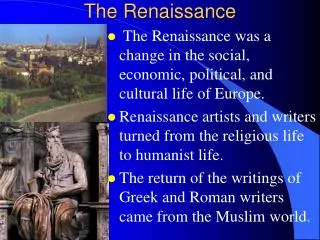
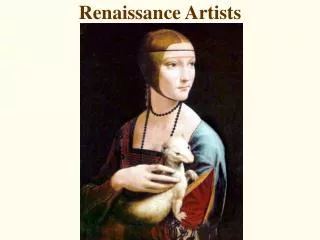
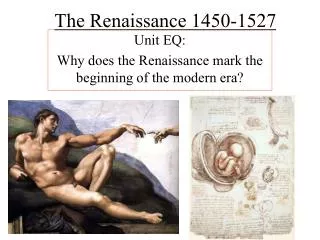
Renaissance Europe • Began in Italy due to coast for trade, Byzantine monks fled from Constantinople bringing Greek/Roman ideas • Humanism – new way of thinking that emphasized reasoning and logic; new secular interests • Protestant Reformation • Scientific Revolution • Commercial Revolution • Age of Exploration • Enlightenment • Art that moves away from purely religious themes – Leonardo da Vinci (Mona Lisa, inventor and artist), Michelangelo (Sistine Chapel), Botticelli (Birth of Venus) – depicting nudes, human anatomy, portraiture – use oil and linear perspective (Brunelleschi) • Vernacularliterature replaces solely in Latin (Shakespeare)
Protestant Reformation • Martin Luther wrote 95 Thesis to protest corruption of Catholic Church – especially indulgences. • Gutenberg’s printing press helps spread it. • John Calvin – predestination • Henry VIII – Act of Supremacy • Reformation will cause a permanent split (schism) in Christianity Counter-Reformation will try to bring people back to Catholic Church: end indulgences at Council of Trent, Inquisitions for heresy (Isabella/Ferdinand), creates Jesuits, Index of banned books
Scientific Revolution • Change from science based on faith and Bible to experimentation • Francis Bacon – scientific method • Copernicus – heliocentric model of universe • Galileo – proved Copernicus right with telescope, will be charged with heresy • Isaac Newton – calculus and laws of motion
Capitalism – Commercial Revolution • Hanseatic League, guilds, and rise of towns replace manorialism • Medici – Florentine banking and political family • Commercial Revolution – rise of capitalism (laissez-faire), joint-stock companies, and bourgeoisie
Age of Exploration - Imperialism • Mercantilism – colonies established for providing motherland with colonies for raw materials and markets for manufactured goods – desired favorable balance of trade. • Motives – “God, Glory & Gold” • Inspired because of the conquest of the Byzantine Empire by Ottomans (Mehmet II) and desire for new route to India and Spice Islands • New Technology – astrolabe, compass, caravel, cartography
Treaty of Tordesillawill establish a line of demarcation between Spanish & Portuguese claims of New World
Major Explorers • Columbus (1492) from Spain to Caribbean, hired by Isabel and Ferdinand (had done Reconquistaof Spain – kicked out Muslims, Jews and Protestants) • Da Gama – Portuguese – south of Africa to India • Magellan – circumnavigated globe • Zheng-He – Ming dynasty from China to Africa • Cortes (Aztecs) and Pizarro (Inca) - conquistadors
Results of Exploration • Columbian Exchange – food stuff and diseases exchanged between New World and Europe/Africa/Asia • Triangular Trade – manufactured goods (guns) from Europe to Africa, African slaves to Caribbean for sugar plantations (Middle Passage) then molasses to Europe • Encomienda – plantations using forced Native American labor • African Diaspora – African slaves transported to Brazil and Caribbean • Native American population declined due to disease and overwork – native culture lost
The Spanish will establish themselves as head of the colonial government. (viceroys) • Native Americans although a majority of population had no say in government. • Long-lasting class resentment based on race/ethnicity • Eventually will lead to revolutions to overthrow Spanish
Absolutism • Rule by divine right • Machiavelli – The Prince • said rulers should rule by fear not love • Louis XIV – France, “Sun King” – built Palace of Versailles, “l’etatc’estmoi” – revoked Edict of Nantes, never allowed Estates General • Ferdinand/Isabella of Spain – Reconquista – kicked out Jews and Moors (Muslims) out of Spain, patronized Columbus’ exploration, later Phillip II – responsible for Armada • Peter the Great – Russia – forced nobles to shave beards, westernize and modernize, built St. Petersburg to get “warm water port” on Baltic Sea – used serf labor, Catherine the Great “enlightened despot”
Limited Monarchy in England • Magna Carta – 1215 • Parliament – 1295 (House of Lords and House of Commoners), controlled taxation • English Bill of Rights – 1688 – created after the Glorious Revolution by William and Mary
Enlightenment • Philosophical movement that says rulers rule not by divine right but by consent of the people,used reason and logic. • Locke – Two Treaties on Government – believed in natural rights and democracy • Montesquieu – 3 branches of government • Rousseau and Hobbes – Social Contract • Adam Smith – Wealth of Nations – laissez-faire economics (government should not intervene in economics)
Native Americans • Mayan– polytheistic (blood sacrifices), stepped pyramid temples, ballcourts, slash and burn farming of Yucatan, hieroglyph carvings, and calendar – shows sophisticated culture • Aztecs – middle of Lake Texoca – hydroponic gardens (chinampas) – made tribute states of neighboring enemies, pyramids, calendars, codex (birch-bark accordion books that show human sacrifice – Spanish will destroy). Peak under Montezuma, destroyed by Cortes • Inca – Andes Mts, terrace farming, Incan Trail and suspension bridges, quipu (knotted rope), destroyed by Pissarro.
Gunpowder Empires • Islamic – based on trade with lots of cultural diffusion leading to golden ages of math, science, etc. • Ottoman – sultans,, harem, Mehmet II took over Constantinople with cannon, Suleiman – absolute monarch w/golden age – will be cut out of trade by European exploration – will attempt to take over Mediterranean stopped by Phillip II – B. of Lepanto. • Safavid – shiites – modern Iran, shah • Moguls – TajMahal, Akbar – religious tolerance, Aurangzeb – ended sati and religious persecution of Hindus
East Asia • Ming – Zheng-He world explorer – wanted to expand trade but bankrupted dynasty • Qing – foreign Manchus, forced Chinese to wear queues. Emperor Kanxi – absolutist • Tokugawa Japan – Edict of Seclusion