
SlideServe
Menu
Préférences
© SlideServe · v2026

Unit Five: Cell Transport

alesia avatar
19 diapositives · 790 Views · Jul 30, 2014

Unit Five: Cell Transport. Passive Transport:. One of the main functions of the cell membrane is to keep the cell’s internal conditions relatively constant. It does this by regulating the movement of molecules. . Plasma Membrane:.
Unit Five: Cell Transport - slide 1
01 / 19Unit Five: Cell Transport
1 / 17

Télécharger la présentation

Unit Five: Cell Transport
Une image / un lien ci-dessous est fourni (tel quel) pour télécharger la présentation

Politique de téléchargement : le contenu du site vous est fourni TEL QUEL pour votre information et votre usage personnel ; il ne peut être vendu, concédé sous licence ni partagé sur d’autres sites sans l’accord de son auteur.Le contenu vous est fourni TEL QUEL, pour votre information et votre usage personnel uniquement. Téléchargez la présentation en cliquant sur ce lien. Lors du téléchargement, si vous ne parvenez pas à télécharger une présentation, l’éditeur a peut-être supprimé le fichier de son serveur.Pendant le téléchargement, si vous ne parvenez pas à obtenir une présentation, le fichier a peut-être été supprimé par l’éditeur.

F I N

Plus de contenu associé

Transcription de la présentation
  1. Unit Five: Cell Transport

  2. Passive Transport: • One of the main functions of the cell membrane is to keep the cell’s internal conditions relatively constant. • It does this by regulating the movement of molecules.

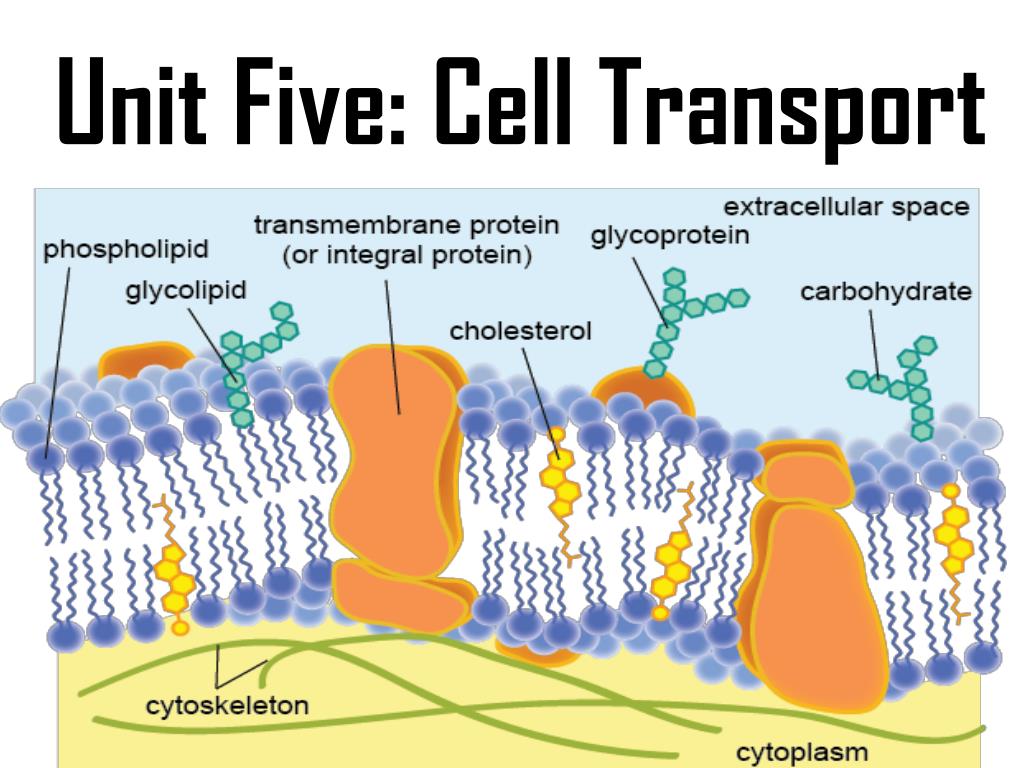
  3. Plasma Membrane: • Recall that the plasma (cell) membrane controls what comes into and out of the cell. • Responsible for maintaining homeostasis. • This means it keeps the proper chemical balance inside the cell. • Water, glucose, amino acids, oxygen, and carbon dioxide are a few examples of things that must be regulated in cells.

  4. Plasma Membrane: Phospholipid Bilayer HYDROPHILIC “water” + “loving” Hydro phillic “heads” Hydro phobic “tails” “water” + “fearing” HYDROPHOBIC

  5. The Plasma Membrane

  6. What else is in the membrane besides phospholipids? • Cholesterol= helps solidify and stabilize the “fluid” membrane. • Carbohydrates =specific pattern on the outer surface of cells for self-recognition. • Proteins= channels for molecules to pass through that otherwise wouldn’t fit.

  7. Characteristics of the Membrane • Fluid Mosaic Model: describes how the parts of the membrane are not stuck in place but have the ability to move around. • Semi-permeable: only allows some molecules to pass through the membrane. YES NO Large molecules Polar molecules Charged molecules • Small molecules • Nonpolar molecules

  8. Membranes are Semi-Permeable • Semi-Permeable = describes a membrane that only allows SOME molecules to pass.

  9. Important Vocabulary: • Concentration Gradient = when the amount of substances (concentration) is different in two places. • Equilibrium = when the amount of substances (concentration) is the SAME in both places.

  10. There are TWO types of transport: ACTIVE TRANSPORT: • This does not occur naturally so they cell has to use energy (ATP) to make active transport occur. • Molecules move from a region of LOW concentration to HIGH concentration. • REQUIRES energy.

  11. HIGH ATP Passive Active LOW LOW

  12. Diffusion: • Diffusion= movement of materials from an area where there is a lot (high concentration) to where there is little (low concentration). • Type of passive transport • Occurs naturally • Does NOT require energy • Due to random motion of molecules

  13. Diffusion: • Diffusion is everywhere! • Air passes through glass in your house. • The smell of cookies baking in the kitchen • How your helium balloon deflates • Occurs in all types of substances! • Solids • Liquids • Gases

  14. How does diffusion work? = impermeable BEFORE… AFTER… Equilibruim! Equilibruim!

  15. Now you try! = impermeable

  16. Facilitated Diffusion: • Facilitated Diffusion: is a specific type of diffusion using PROTEINS to transport large or charged molecules into the cell. • Remember that some molecules cannot get through the semi-permeable membrane on their own (large, polar, or charged). • This type of transport is still passive and does NOT require energy.

  17. Facilitated Diffusion:

  18. So which is which? Diffusion Facilitated Diffusion

  19. Turn to page 204 in your textbook. Draw a diagram representing the cell membrane. Your drawing should include all of the following parts:- Phospholipid bilayer- membrane proteins-carbohydrate chain-a drawing of a labeled phospholipid-label the inside and outside of the cell(Yes, you need to use color!)