Download
1 / 30
300 likes | 406 Vues
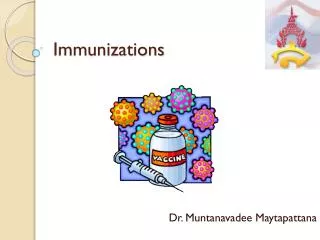
Explore the history of vaccines, mechanisms of immunity, and future developments in immunization. Learn about innate and adaptive immunity, active and passive immunity, different types of vaccines, and the importance of immunization coverage.

E N D
Amazing Fact “An estimated 2.1 million people around the world died in 2002 of diseases preventable by widely used vaccines.1 With an investment of 3 billion USD a year, every child in the developing world could receive complete immunization coverage.2 1 World Health Organization. Immunization Against Diseases of Public Health Importance. March 2005.) 2 UNICEF. Immunize Every Child: GAVI Strategy for Immunization Services. February 2000)
History • Edward Jenner • Cowpox and smallpox experiments • Louis Pasteur • Cholera work • Originator of term “vaccine”
Mechanisms of Immunity • Innate immune system • Present from birth • Does not differentiate challenge • Adaptive immune system • Synonyms: acquired or specific immunity • Responds to specific challenges
Innate Immunity • Nonspecific response • Anatomic barriers • Skin and mucosal membranes • Physiologic barriers • Acidity and chemical mediators • Phagocytosis • Neutrophils and macrophages • Inflammation • Antibacterial and stimulatory effects • Natural killer cells • Tumor cytotoxicity
Adaptive Immunity • Responds to specific antigenic challenge • Cells involved • T lymphocytes (T cells) • B lymphocytes (B cells) • Types of adaptive responses • Cell-mediated (cellular) immunity • Humoral immunity
Cell-mediated Immunity • Involves T lymphocytes • Derived from cells in the bone marrow • Mature and differentiate in the thymus • Help eliminate intracellular organisms • Present protein antigens to B cells • Secrete cytokines • Develop specific functions after antigenic exposure
Memory cell T lymphocyte Antigen Cytotoxic cell Helper cell Suppressor cell Lymphocytic stem cell Antibody producing cell Memory cell B lymphocyte Antigen Figure 2: Functional lymphoid populations following antigenic stimulation
Humoral Immunity • Involves B lymphocytes • Primary defense against extracellular organisms • Recognize antigenic determinants (epitopes) leading to antibody production by plasma cells • Antibodies produced • IgM, IgG, IgA, IgD, IgE
Humoral Immunity • Chief functions of antibodies • Neutralize bacterial toxins • Neutralize viruses • Promote phagocytosis • Activate inflammatory response • Antibodies at work • Primary and secondary responses
1st exposure to antigen 2nd exposure to antigen Antibody Titer Time Figure 3: Primary and secondary response curves
Active and Passive Immunity • Active immunity • Immunocompetent individual produces immune products after exposure to foreign organism • Immune products: antibodies, memory cells • May be naturally developed (natural infection) or artificially acquired (vaccine)
Active and Passive Immunity • Passive immunity • Involves transfer of preformed antibodies • May involve natural acquisition (maternal- fetal transfer) or may be acquired (injection of immunoglobulin)
Active and Passive Immunity • Differences in protection • Active immunity • Long-term protection due to production of memory cells • Passive immunity • Short-term protection due to lack of memory cell production
Vaccines • Mimic natural infection • Stimulate the immune system • Key requirements for success • Immunologic memory • Specificity
Vaccines • Goal • Stimulate memory T and B cells • To induce specific immunity • Eliminate organisms • Neutralize bacterial toxins
Vaccines • Live, attenuated vaccine • Contains weakened (attenuated) form of live organisms • Advantage: • produces strong cellular and humoral responses • Disadvantages: • chance organism may become virulent again • requires refrigeration
Vaccines • Inactivated vaccines • Killed organisms • Advantages: • Safer and more stable than live vaccines • Usually do not require refrigeration • Some may be freeze-dried • Disadvantage: • May stimulate weaker response than live vaccines
Vaccines • Toxoid vaccines • Treated microbial toxins • Advantage: • Stimulate strong antibody responses that eliminate harmful toxins
Vaccines • Subunit vaccines • Composed of selected microbial epitopes • Often administered with adjuvants such as aluminum salts • Advantages: • Greater specificity • Adverse reactions less likely
Vaccines • Conjugate vaccines • Couple polysaccharide antigens to protein carrier • Advantage: • Better recognition by the immune system to stimulate strong immune response especially in infants and children
Future Vaccines • DNA vaccines • Use organism’s genes to invoke antigen expression in host • Recombinant vector vaccines • Use attenuated organism to introduce organism’s DNA into host • Hurdles to vaccine development • Mutation of organisms especially viruses • Genetic complexity of certain organisms
Immunization of Selected Groups • Childhood immunizations • Recommendations approved yearly by • Centers for Disease Control and Prevention (CDC) • American Academy of Pediatrics • American Academy of Family Physicians
Immunization of Selected Groups • Adult immunizations • Influenza • Pneumococcal • Travelers • Depends on site of travel • Workers exposed to biological agents in work environment • Anthrax • Smallpox
Effectiveness of Vaccines • Generally effective in most populations • Poor-responders • Small group of individuals • Herd (community) immunity • Immunity developed by group of vaccinated individuals • Impediments to achieving herd immunity • Concerns regarding adverse side effects • Costs of vaccines
Barriers to Widespread Coverage • Developed world • Access and cost issues among certain populations • Language barriers • Failure to obtain booster shots or complete series • Fears concerning vaccination • Underestimation of disease risk
Barriers to Widespread Coverage • Developing Countries • Logistical issues • Storage requirements • Poor infrastructure • Lack of roads • Personnel issues • Shortage of health care workers