Download
1 / 13
130 likes | 239 Vues
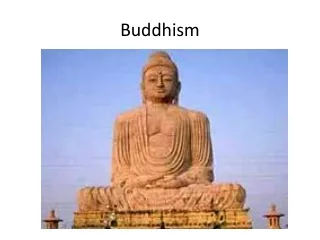
Buddhism, founded by Siddhartha Gautama in 560 BCE, offers profound teachings on the nature of suffering and the path to enlightenment. It emphasizes the Four Noble Truths, which reveal the existence of suffering and how it can be overcome through the Noble Eightfold Path. This path involves right understanding, speech, action, livelihood, and meditation, leading to Nirvana—total liberation and contentment. Buddhism encourages compassion through its different branches, Theravada and Mahayana, each expressing unique paths to enlightenment while maintaining the core teachings of the Buddha.

E N D
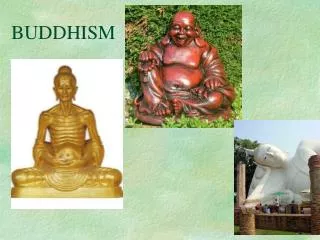
BUDDHISM • Siddhartha Gautama • born in Nepal @ 560 BCE • born a Hindu prince • member of the Kshatriya caste • gave up his wealth • set out on a journey of self-discovery • why does suffering exist? • The Middle Way • Four Noble Truths • Noble Eight-Fold Path • NIRVANA • SUTRAS
The FOUR NOBLE TRUTHS 1. Suffering exists 2. Suffering exists from attachment to desires 3. Suffering ceases when attachment to desire ceases. 4. Freedom from desire/suffering is possible by practicing the Noble Eightfold Path
Noble Eight-Fold Path Wisdom: Meditation: 1. Right View 6. Right Effort 2. Right Thought 7. Right Mindfulness Morality 8. Right Contemplation 3. Right Speech 4. Right Action 5. Right Livelihood
NIRVANA • Total, complete contentment • Escapes the hindrances of life • Free from suffering from one’s own desires • What happens when the soul escapes from the wheel of life? • TATHAGADA (thus gone) • like the flame of match that is extinguished
FIVE HINDRANCES 1. Lust 2. Ill will 3. Sloth and laziness 4. Restlessness and worry 5. Skeptical doubt Daily Dharma: Mind Hindrances
Seven Factors of ENLIGHTNMENT 1. Attentiveness 2. Investigation of the Law 3. Energy 4. Rapture 5. Tranquility 6. Concentration 7. Equanimity three bodily states: standing, sitting, and lying down
TEN Perfections 1. Generosity 8. Resolution 2. Morality 9. All-embracing 3. Renunciation kindness 4. Wisdom 10. Equanimity 5. Energy 6. Forbearance 7. Truthfulness
Four Boundless States 1. Loving Kindness 2. Compassion 3. Sympathetic Joy 4. Equanimity
THERAVADA BUDDHISM • “Doctrine o/t Elders” • conservative branch • The Little Wheel • less followers • Buddha is a teacher • Spread to Sri Lanka, Myanmar, Thailand
THERAVADA BUDDHISM • ideal is arhat • become an enlightened saint • wisdom • few possessions • begging bowl • three colored robes • a belt • a mending needle • fan to cover face • razor to shave head • water strainer
MAHAYANA BUDDHISM • “Great Vehicle” or “Big Wheel” • majority of followers • non-monastic life • Buddha is a god • Spread to China, Tibet, Korea & Japan • ideal is compassion • can attain nirvana through assisting others • Bodhisattva: holds back on attaining nirvana to help others
BUDDHISM • "Buddhism has the characteristics of what would be expected in a cosmic religion for the future: it transcends a personal God, avoids dogmas and theology; it covers both the natural & spiritual, and it is based on a religious sense aspiring from the experience of all things, natural and spiritual, as a meaningful unity." Albert Einstein