Dose-Response Analysis of Nitric Oxide Modulation in Hypoxic and Normoxic Rat Models
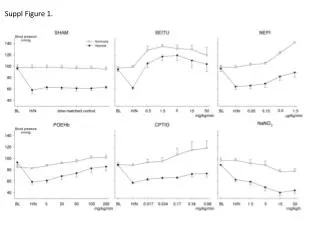
This study presents a series of supplementary figures illustrating the dose-response effects of nitric oxide (NO) modulation in both hypoxic and normoxic conditions. Baseline measurements and post-treatment assessments are provided for various groups, including control (SHAM), non-selective NOS inhibitor (SEITU), norepinephrine (NEPI), and different scavengers (POE-Hb and C-PTIO). The experimental setup involved a range of doses and multiple groups, with statistical significance indicated by p-values. Results support understanding the physiological responses to NO modulation in a controlled animal model.

Dose-Response Analysis of Nitric Oxide Modulation in Hypoxic and Normoxic Rat Models
E N D
Presentation Transcript
Supplementary figure S1: Dose-response curves BL: baseline measurement; H/N: measurement after randomisation to hypoxia or normoxia. Open symbols represent normoxic rats, closed symbols are hypoxic rats. SHAM: normoxic and hypoxic control groups; SEITU: non-selective NOS inhibitor S-ethylisothiourea group; NEPI: norepinephrine group; POE-Hb: haem-based NO scavenger pyridoxylatedhaemoglobin poly-oxoethylene group; C-PTIO: organic NO scavenger 2-(4- carboxyphenyl)-4,4,5,5-tetramethyl-imidazoline-1-oxyl-3-oxide group; NaNO2: sodium nitrite group. N=4 animals per group.
Supplementary figure S2: Dose-response to L-NAME BL: baseline measurement; H/N: measurement after randomisation to hypoxia or normoxia. Open symbols represent normoxic rats, closed symbols are hypoxic rats. LNAME: N (G)-nitro-L-arginine methyl ester. N=3 animals per group.
Supplementary figure S3: Haemodynamic effects of NO scavenging after hypoxia and NOS inhibition and after hypoxia, NOS inhibition and nitrite administration BL: baseline measurement; SEITU: non-selective NOS inhibitor S-ethyl-isothiourea; NaNO2: sodium nitrite; POE-Hb: haem-based NO scavenger pyridoxylatedhaemoglobin poly-oxoethylene. *p<0.05 vs baseline; #p<0.05 vs previous step. N=6 animals per group.