Buddhism
170 likes | 274 Vues
Buddhism, founded by Siddhartha Gautama, known as "The Buddha," emerged in the 5th century. It emphasizes the Four Noble Truths and the Noble Eightfold Path as keys to overcoming suffering. With origins in India, Buddhism has diversified into three major traditions, spreading south and north over centuries. It emphasizes ethical practices like almsgiving, meditation, and a code of conduct known as Vinaya. This overview explores its teachings, sacred sites, rituals, and the contemporary relevance of Buddhism through its core practices of mindfulness and generosity.


Buddhism
E N D
Presentation Transcript
Buddhism By: Whitney Lucas & Kate Skrade
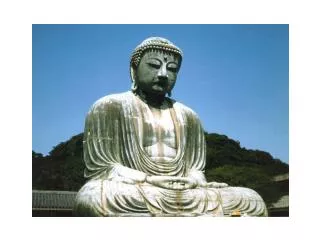
Siddhartha Gautama • Born in the 5th century • Born a prince • Gautama became enlightened • “The Buddha” or “The Awakened One” • Small town of Sarnath • Arhat Origin of Buddhism
Follows three main traditions • Buddhism began to spread Southwards from its place of origin • Also moved Northwards • Previously died out • Modern Times • Three Main Schools Diffusion of Buddhism
Vinaya • Strict code of conduct • Food • Dana • Act of Generosity • Funeral Practices Common Practices
In Most Religions, a marriage is taken before God. • There is no “God” in Buddhism • Affirmation of the couple’s commitment • Buddha did not prescribe a form of marriage service Marriage
Writing was not common • Written down on Ola (Palm) leaves • Teachings are preserved in the ancient Pali Language • Today’s Practices • Tipitaka • Three Baskets • VinayaPitaka • Disciplinary rules for monks • SuttaPitaka • Discourses • AbhidhammaPitaka • Higher Teachings Why do Buddhists Chant?
Most important alms giving ceremony of the Buddhist year • Over 2,500 years • Marks the end of the annual Rains Retreat, or Vassa • Sangha Monks and Nuns • How did the Kathina Festival Originate? The Festival of Kathina
Way Taught by Buddha • Known as the Middle Path • Right Understanding • Right Thought • Right Speech • Right View • Right Livelihood • Right Action • Right Mindfulness • Right Concentration Noble Eightfold Path
Life means suffering • The origin of suffering is attachment • The cessation of suffering is attainable • The path to the cessation of suffering The Four Noble Truths
Harming Living beings • Taking things not freely given • Sexual Misconduct • False speech • Intoxicating drinks and drugs causing heedlessness The Precepts
Taking untimely meals • Dancing, singing, music and watching grotesque mime • Use of garlands, perfumes and personal adornment • Use of high seats • Accepting gold or silver The Precepts Continued..
The greatest achievement is selflessness. • The greatest worth is self-mastery. • The greatest quality is seeking to serve others. • The greatest precept is continual awareness. • The greatest medicine is the emptiness of everything. • The greatest action is not conforming with the worlds ways. • The greatest magic is transmuting the passions. • The greatest generosity is non-attachment. • The greatest goodness is a peaceful mind. • The greatest patience is humility. • The greatest effort is not concerned with results. • The greatest meditation is a mind that lets go. • The greatest wisdom is seeing through appearances. About Buddhism…
Lumbini • “The Buddha” was born at this site • Bodhgaya • “The Buddha” attained enlightenment & became “The Buddha” • Sarnath • “The Buddha” met his five disciples and delivered his firs sermon • Kushinara • “The Buddha” Died here Holy Places of Buddhism
Colombo, Sri Lanka • The Buddha intervened in a fight between two clans • Unrest still remains • Recent clash between Buddhist and Muslim • Destruction of the Quran • Thailand • Muslim rebels have been involved in a bloody insurgency In Southern Thailand • A country that is 95% Buddhist • Tibet • Country was annexed by Chinese Communists in late 1950s Conflicts of Buddhism
Hardy, Julia. Buddhism Beginnings. Patheos Inc., 2011. Web. 11 Jan. 2012. • N.a. London Buddhist Vihara. N.p., n.d.Web.11 Jan. 2012. • N.a. Lumbini-Birth Place of Buddha.N.p.,2008.Web.11 Jan. 2012. • N.a.Spreadof Buddhism.N.p.,n.d.Web.11 Jan.2012. Sources