Understanding Drift Current Density in Semiconductors
This text explores the concept of drift current density in semiconductors, focusing on the behavior of electrons and holes under an electric field E. It explains how charge carriers, including electrons and holes, move with a drift velocity (vd) and how this movement contributes to electric current. The relationship between charge, mobility, and conductivity is examined, revealing key formulas for calculating the drift current density in intrinsic semiconductors where the electron concentration (n) equals the hole concentration (p), both equaling the intrinsic carrier concentration (ni).

Understanding Drift Current Density in Semiconductors
E N D
Presentation Transcript
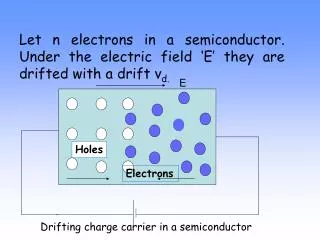
Let n electrons in a semiconductor. Under the electric field ‘E’ they are drifted with a drift vd. E Holes Electrons Drifting charge carrier in a semiconductor
Then current density Where e is the charge of an electron. Then conductivity
The drift velocity is also given by Where is the mobility of electrons. Substituting the above values,
In case of semiconductor, the drift current density due to electrons is given by Then the total drift current density