The Origins and Progress of World War II: From Invasion of Poland to Allied Victory
190 likes | 302 Vues
This overview of World War II chronicles its beginnings with Germany's invasion of Poland and the subsequent actions of the Allied powers. It discusses the failure of appeasement, the secret pact between Germany and the USSR, and the escalation of conflict leading to Britain and France's declarations of war. Major developments are highlighted, including the fall of France, key battles in Britain, and the significant shifts in power as the US joins the war following the attack on Pearl Harbor. The impact of innovations in warfare and the eventual turning of the tide is examined, leading to the Allies' triumph and the Yalta Conference’s agreements.


The Origins and Progress of World War II: From Invasion of Poland to Allied Victory
E N D
Presentation Transcript
Invasion of Poland • Allied appeasement emboldens Hitler • Germany & USSR sign secret non-aggression pact; agree to divide Poland (August 1939) • Germany invades Poland (September 1939) • Britain & France declare war; do nothing militarily
Fall of France (1940) • French content to wait behind Maginot Line • Germany invades France (May 1940); sidesteps Maginot Line through the Netherlands, Belgium • Italy declares war on France • Paris captured; France divided into occupied & Vichy France • “Miracle of Dunkirk” saves British army
Battle of Britain (1940) • Italy, Germany invade Greece, Yugoslavia • Britain stands alone • Churchill replaces Chamberlain as Prime Minister • Hitler orders bombing campaign to force Britain to negotiate peace • Luftwaffe targets military & civilian targets • Radar & determination save Britain
Battle of the Atlantic • German submarines hope to starve Britain into surrender • Access to French & Belgian coast give Germany secure bases • Allied convoys develop to deal with threat • Britain secures American aid, destroyer escorts
Invasion of Russia (1941) • Raw materials & lebensraum motivate German invasion • Soviet Army, leaderless, suffers catastrophic loss • Russians adopt “scorched earth” policy • Onset of winter halts German advance • Russia on the ropes, Britain under siege • Japan seizes Allied colonies in Asia
Pearl Harbor (December 7, 1941) • Japan reliant on imports of fuel, raw materials • American Pacific presence threatens Japanese expansion • Surprise attack on Pacific Fleet at Pearl Harbor (Hawaii) & Philippines • Sinks American battleship fleet, misses aircraft carriers • US declares war on Japan • Germany declares war on US
By the year… • 1931: Japan invades Manchuria • 1935: Mussolini invades Ethiopia; Hitler ignores Versailles • 1936: Remilitarization of Rhineland • 1937: Nazi assistance to Fascist Spain; Rape of Nanking • 1938: Anschluss with Austria, seizure of Sudetenland, Czechoslovakia • 1939: Invasion of Poland • 1940: Invasion of France • 1941: Invasion of Soviet Union, Pearl Harbor
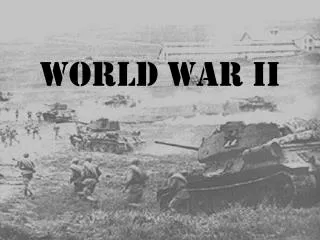
Innovations in War: Land • Fast, powerful tanks • Motorized transport • Submachine guns, automatic rifles • Blitzkrieg (lightning war) combines: • Tanks • Infantry • Air support • Radio communication
Innovations in War: Sea • Improved submarines • Radio • “Wolfpack” tactics • Scout subs locate targets, coordinate mass sub attack • Sonar, depth charges • Liberty ships • Aircraft carrier: most critical warship of WWII
Innovations in War: Air • Heavy & close-support bombers • Rockets • Cruise (V-1) & ballistic (V-2) missiles • Radar • Jet aircraft • Strategic bombing: • Bombing campaign directed against civilian and/or industrial targets • Atomic weapons
The Tide Turns • US Navy wins stunning naval victory at Midway (1942); turning point in Pacific war • Siege of Stalingrad destroys German army in the east (1942-1943) • Allies invade Italy (1943) • Allied invasion of France (D-Day June 1944)
The End Game • Day & night bombing of German industry • “Island hopping” campaigns of the Pacific gradually recapture isolated, unsupplied Japanese outposts • Massive Soviet efforts sweep across eastern Europe • Berlin falls to Soviets, European war ends on May 7, 1945 (V-E Day)
The Industrial War Armaments Production 1940-43 (billions of Dollars) Aircraft Production 1939 & 1944 Allies: 1939 1944 USA 5,856 96,318 USSR 10,382 40,300 Britain 7,940 26,461 Total 24,178 163,079 Axis: Germany 8,295 39,807 Japan 4,467 28,180 Italy 1,800 N/A Total 14,562 67,987 Allies: 1940 1943 • USA 1.5 37.5 • USSR 5.0 13.9 • Britain 3.5 11.1 Total 10.o 62.5 Axis: • Germany 6.0 13.8 • Japan 1.0 4.5 • Italy .75 N/A Total 7.75 18.3
The Horror of Total War: Axis • 50 million dead (30 million of those civilians) • Germany: • The Holocaust: 6 million Jews & others • Massacre of civilians & prisoners of war • Human experimentation • Forced labor • Unrestricted submarine warfare • “Vengeance” weapons • Japan: • Between 3-10 million Chinese civilians • Rape of Nanking • Massacre of civilians & POWs • Human experimentation, biological & chemical weapons • Forced labor • “Comfort” women
The Horror of Total War: Allies • USA: • Daylight strategic bombing campaign targeted industry & enemy morale • Conventional (Germany & Japan) & nuclear bombing (Japan) • Britain: • Nighttime strategic bombing (Germany) • USSR: • Massacre of Polish civilians • Massacre of German POWs • Widespread massacre of German civilians & systematic rape of German women
Planning for the Peace: Yalta Conference February, 1945 • USA (Roosevelt), USSR (Stalin) & Britain (Churchill) • Agreements: • Unconditional surrender of Germany • Germany to be divided • Creation of a Poland dominated by USSR • USSR to participate in the United Nations • USSR to declare war on Japan
Planning for the Peace: Potsdam Conference Jul-Aug, 1945 • USA (Truman), USSR (Stalin) & Britain (Atlee) • Agreements: • Demilitarization & denazification of Germany • War crimes trials • Immediate surrender of Japan • USSR given free-hand in Eastern Europe • Truman hints about a new “super-weapon” • Sets stage for Cold War rivalry between USA & USSR