Understanding Scientific Notation: Conversion Between Forms and Comparison
This lesson introduces scientific notation, a method for writing very large or small numbers. It explains how to convert numbers between scientific notation and standard form. Students will learn that scientific notation consists of a leading factor (between 1 and 10) multiplied by a power of 10. Through examples and practice, learners will master both conversions, understanding how to count digits and place decimals correctly. They will also practice comparing numbers in scientific notation, reinforcing their understanding through hands-on activities.

Understanding Scientific Notation: Conversion Between Forms and Comparison
E N D
Presentation Transcript
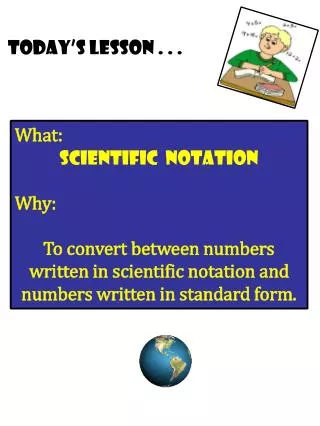
Today’s lesson . . . What: Scientific Notation Why: To convert between numbers written in scientific notation and numbers written in standard form.
What is it? • We use scientific notation to write very ___________________ or very __________________ numbers. • Scientific notationis a # written as a • ____________________________________ sentence. • The leading factor MUST be a number greater than or equal to 1, but less than _____________. • The second factor must be a _________________ of 10. LARGE small multiplication ten (10) power Example: 2.5 x 105
= 5.9 x 10⁷ Place Decimal AFTER first digit! Count digits to right of decimal point! = 1.4 x 10¹¹ Place Decimal AFTER first digit! Count digits to right of decimal point! From Standard form to scientific notation: 1. 5 9 , 0 0 0 , 0 0 0 2. 1 4 0 , 0 0 0 , 0 0 0 , 0 0 0 = 9.5 x 10³ Place Decimal AFTER first digit! Count digits to right of decimal point! = 2.52 x 10⁹ Place Decimal AFTER first digit! Count digits to right of decimal point! 3. 9 , 5 0 0 4. 2 , 5 2 0 , 0 0 0 , 0 0 0
From scientific notation to standard form: = 6,320,000,000 Count digits to right of decimal point! 6.32 x 10⁹ 6. 3.4 x 10⁵ How many more do we need to equal exponent #?? That’s the # of zeros we need!! = 340,000 Count digits to right of decimal point! How many more do we need to equal exponent #?? That’s the # of zeros we need!! = 60,000 Count digits to right of decimal point! 7. 6 x 10⁴ 8. 2.08 x 10⁷ How many more do we need to equal exponent #?? That’s the # of zeros we need!! = 20,800,000 Count digits to right of decimal point! How many more do we need to equal exponent #?? That’s the # of zeros we need!!
Comparing numbers in scientific notation: Order the following from least to great: 10. Order the following from greatest to least:
NAME:__________________________ DATE: ______/_______/_______ PAIR/CHECK/SWITCH Scientific notation FORM “A”
NAME:__________________________ DATE: ______/_______/_______ PAIR/CHECK/SWITCH Scientific notation FORM “B”
Math-7 NOTES DATE: ______/_______/_______ NAME: What: Scientific Notation Why: To convert between #’s written in scientific notation and #’s written in standard form. What is it? • We use scientific notation to write very ____________________________ or • very _________________________ numbers. • Scientific notationis a number written as a _________________________________ • sentence. • The leading factor MUST be a number greater than or • equal to 1, but less than ________________. • The second factor must be a ________________________ of 10. • Example: 2.5 x 10⁵ From Standard form to scientific notation: 1. 5 9 , 0 0 0 , 0 0 0 2. 1 4 0 , 0 0 0 , 0 0 0 , 0 0 0 3. 9 , 5 0 0 4. 2 , 5 2 0 , 0 0 0 , 0 0 0
From scientific notation to standard form: 6.32 x 10⁹ 6. 3.4 x 10⁵ 7. 6 x 10⁴ 8. 2.08 x 10⁷ Comparing numbers in scientific notation: Order the following from least to great: 10. Order the following from greatest to least:
NAME:__________________________________________________________________________NAME:__________________________________________________________________________ DATE: ______/_______/____________ PRACTICE IT “Scientific notation” (turn over)
NAME:__________________________________________________________________________NAME:__________________________________________________________________________ DATE: ______/_______/____________ PRACTICE IT “Scientific notation”