Strategies and Consequences of World War II: Allies vs. Axis Powers
World War II was marked by the fierce conflict between the Allies and the Axis Powers, primarily composed of Germany, Italy, and Japan. Key events include Japan's brutal aggression in China, the Italian invasion of Ethiopia, and the rapid rise of Hitler's Germany. As the war escalated, the United States became a crucial player following the attack on Pearl Harbor. Significant battles, such as Stalingrad and D-Day, turned the tide against the Axis. The war concluded with Japan's surrender after the atomic bombings, reshaping global dynamics and geopolitics.

Strategies and Consequences of World War II: Allies vs. Axis Powers
E N D
Presentation Transcript
The Second World War • Allies vs. Axis Powers • Italy, Germany and Japan form Axis • “Revisionists:” wished to revise post-World War I peace treaties • Allies initially follow policy of appeasement
Japan’s War in China • Conquest of Chinese Manchuria 1931-1932 • Full-scale invasion in 1937 • The Rape of Nanjing • Ariel bombing of urban center • 400,000 Chinese used for bayonet practice, massacred • 7,000 women raped • 1/3 of all homes destroyed • Japan signs Tripartite Pact with Germany, Italy (1940)
Chinese Resistance • Japanese aggression spurs “United Front” policy between Chinese Communists and Nationalists • Guerilla warfare ties down half of the Japanese army • Yet continued clashes between Communists and Nationalists • Communists gain popular support, upper hand by end of the war
Italian Aggression • Benito Mussolini invades Ethiopia with overpowering force • 2,000 Italian troops killed, 275,000 Ethiopians killed • Also takes Libya, Albania • L.O.N. fails to act in a forceful way
Germany • Adolf Hitler (1889-1945) withdraws from League of Nations • Remilitarizes Germany • Anschluss (“Union”) with Austria, 1938 • Pressure on Sudetenland (Czechoslovakia)
Munich Conference (1938) • Italy, France, Great Britain, Germany meet • Allies follow policy of appeasement • Hitler promises to halt expansionist efforts • British Prime Minister Neville Chamberlain (1869-1940) promises “peace for our time” • Hitler signs secret Russian-German Treaty of Non-Aggression (Molotov-Ribbentrop Pact, August 1939)
Invasion of Poland and France • September 1, 1939 • Blitzkrieg: “lightning war” strategy • Air forces soften up target, armored divisions rush in • German U-boats (submarines) patrol Atlantic, threaten British shipping
The Fall of France • 1940: Germany occupies Denmark, Norway, Belgium, France • Hitler forces French to sign armistice agreement in same railroad car used for the armistice imposed on Germany in 1918
The Battle of Britain • Air war conducted by the German Luftwaffe • “The Blitz” • 40,000 British civilians killed in urban bombing raids • Especially London • Royal Air Force prevents Germans from invading
Operation Barbarossa • Lebensraum (“living space”) • June 22, 1941 Hitler double-crosses Stalin and invades USSR • Stalin caught off-guard, rapid advance • But severe winter, long supply lines weakened German efforts • Soviets regroup and attack Spring 1942 • Turning point: Battle of Stalingrad (ends February 1943)
US Involvement in WWII before Pearl Harbor • US initiates “cash and carry” policy to supply Allies with arms • “lend-lease” program: US lends war goods to Allies, leases naval bases in return • US freezes Japanese assets in US • US places embargo on oil shipments to Japan • Japanese Defense Minister Tojo Hideki (1884-1948) plans for war with US
Pearl Harbor (December 7, 1941) • FDR: “A date which will live in infamy” • Destroys most of the Pacific Fleet (U.S. Aircraft Carriers unharmed) • Hitler, Mussolini declare war on the US on December 11 • US joins Great Britain and the USSR
Japanese Victories • Japan dominates south-east Asia, Pacific islands • Establishes “Greater East Asia Co-Prosperity Sphere”
Defeat of the Axis Powers • Key factors: personnel reserves, ****industrial capacity • US joining the war turned the tide • Shipbuilding, automotive production especially important
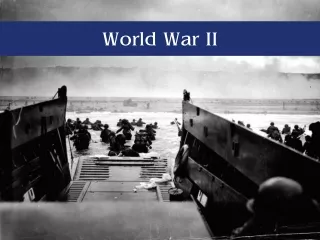
Allied Victory in Europe • Red Army (USSR) gains offensive after Stalingrad (February 1943) • British, US forces attack in North Africa, Italy • D-Day: June 6, 1944, British and US forces land in France • US, Britain bomb German cities • Dresden, February 1945: 135,000 Germans killed in shelters • 30 April 1945 Hitler commits suicide, 8 May Germany surrenders
Turning the Tide in the Pacific • US code breaking operation Magic discovers Japanese plans • Battle of Midway (4 June 1942) • US takes the offensive, engages in island-hopping strategy • Iwo Jima and Okinawa • Japanese kamikaze suicide bombers • Savage two-month battle for Okinawa
Japanese Surrender • US firebombs Tokyo, March 1945 • 100,000 killed • 25% of buildings destroyed • Atomic bombs dropped on Hiroshima and Nagasaki, August 1945 • Emperor Hirohito (1901-1989) surrenders unconditionally September 2, 1945
Justification For the Use of the Bomb • To save lives (estimates of taking the Japanese homeland by conventional methods ran as high as 1 million men) • Intimidate the Soviet Union and the rest of the world • $ 2 billion were spent/ 4 years spent • (Perhaps) Revenge
Varieties of Wartime Occupation • Independent States with enforced alliances • Thailand, Denmark • Puppet States • Manchukuo, Vichy France • Military Administration • Indochina, Poland
Collaboration • For some, opportunity for social mobility under conquerors • Sometimes considered a lesser evil than military administration
Resistance • Military forms of resistance • Intelligence gathering • Protecting refugees • Symbolic gestures • German, Japanese policies of collective punishment
Nazi Genocide and the Jews • Jews primary target of Nazi genocidal efforts • Other groups also slated for destruction: Roma (Gypsies), Homosexuals, Jehovah’s Witnesses • Einsatzgruppen (mobile killing squads) follow German army into USSR with Operation Barbarossa • Round up of Jews and others, machine-gun executions of 1.4 million • Later in 1941 decided on “Final Solution:” deportation of all European Jews to Death Camps- • Become official Nazi policy Wannsee Conference (Jan 1942)
The Holocaust • Jews deported from ghettos all over Europe in cattle cars, spring 1942 • Destination: six specially designed Death Camps in Eastern Europe • Technologically advanced, assembly-line style of murder through poison gas (Zyklon B) • Conservative estimates: 5.7 Jews killed
Women’s Roles • Women occupy jobs of men away at war • Also take on “head of household” duties • Temporary: men returning from war displace women • Yet lasting impact on women’s movement
Origins of the Cold War • US, USSR, Great Britain unnatural allies during World War II • Tensions submerged until close of war • Yalta and Potsdam Conferences (1945) • Stalin, Churchill, Roosevelt/Truman • Decided on USSR declaration of war vs. Japan, setting up of International Military Tribunal • Free elections for Eastern Europe • Stalin arranges pro-communist governments in Eastern European countries • 1946: “Iron Curtain” descends
The Truman Doctrine (1947) • World divided into free and enslaved states • US to support all movements for democracy • “containment” of Communism • Provides aid to Turkey and Greece • NATO and the Warsaw Pact established • Militarization of Cold War
The Marshall Plan George C. Marshall • Proposed in 1947, $13 billion to reconstruct western Europe (contains Communism) • USSR establishes Council for Mutual Economic Assistance (COMECON), 1949
The United Nations • 1941- Atlantic Charter FDR & Churchill called for the creation of a new world organization • April –May 1945 delegates from 50 nations created the UN Charter • Goals of the U.N. (Based on FDR’s Four Freedoms) • -protected the rights of all people • -improve people’s lives around the world • -peaceful resolutions to international problems