Download
1 / 49
490 likes | 629 Vues
This analysis explores the key events and figures that shaped World War II, focusing on the rise of dictators in Italy, Germany, the Soviet Union, and Japan. Benito Mussolini's fascism and Adolf Hitler's Nazi regime emerged amidst post-World War I dissatisfaction. Joseph Stalin's brutal governance and Japan's aggressive expansion led to the formation of the Axis Powers. The entry of the U.S. into the war marked a turning point, culminating in the defeat of Axis forces and the emergence of superpowers. The lasting impact of the war and its toll on humanity are also discussed.

E N D
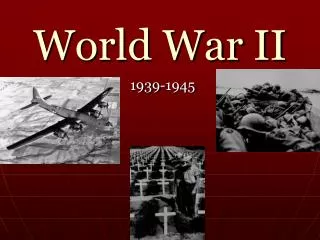
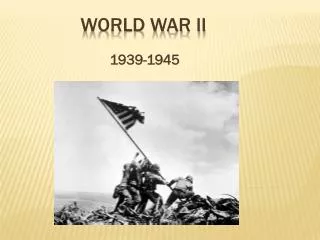
World War II 1939-1945
The Rise of Dictators: Italy Some countries were not satisfied from the outcome of World War I • Italy had won little in the Versailles treaty • Benito Mussolini formed a military-dominated government called fascism • Italy quit the League of Nations • Mussolini took over the African nation Ethiopia in 1935 and Italy’s neighbor Albania in 1939
The Rise of Dictators: Germany • The Depression hit Germany extremely hard • Adolf Hitler took over the country with his National Socialist (Nazi) Party • Blamed the Jews for Germanys problems • Violated the Treaty of Versailles by building up military and expanding • Helped Francisco Franco (fascist) win Spanish Civil War
The Rise of Dictators: Soviet Union • Joseph Stalin led the Communist Party • Executed 30 million Russians and sent millions to labor camps • Signed a non-aggression pact with Germany-they agreed to not attack each other and divide up Poland • Germany broke pact and invaded Soviet Union • Joined Allied Powers: Britain, France, U.S.
The Rise of Dictators: Japan • Invaded Manchuria, China to take over land and resources • Attacked U.S. gunboat and U.S. oil tankers in China • FDR froze Japanese assets and approved an embargo on shipments of gas, tools, steel and iron to Japan • Hideki Tojo became prime minister of Japan • 11/20/41: Japan demanded that U.S. unfreeze assets, supply gasoline and stop aid to China • U.S. knew attack was coming but did not know where • Germany, Italy, and Japan formed an alliance called the Axis Powers
German Expansion • Germany annexed Austria • Sudetenland-bordering area of Czechoslovakia • Czechoslovakia • 9/1/39 invaded Poland and WWII began when Britain+France declared war 9/3/39 • U.S. declared neutrality • Other neutral countries: Spain, Switzerland, Sweden, Ireland, Turkey
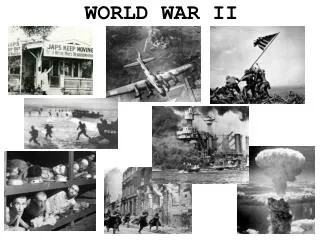
From Neutrality to War • U.S. declared neutrality 1935-1939 • Selective Training and Service Act (1940): first peacetime draft in U.S. history • Lend-Lease Act in 1941 appropriated $7 billion for ships, tanks, planes, and supplies to non-Axis countries • 12/7/41 “a day which will live in infamy” Pearl Harbor: 2 hour attack destroyed about 20 warships, 200 aircraft, and killed 2400 Americans
U.S. Disadvantages • Multi-front war: Western Europe, Pacific, Mediterranean, and North Africa • Germany converted to war production in the 1930s, better prepared • Japanese had taken Allied Territories: Guam, Hong Kong, Thailand, Philippines • Germany and Italy controlled most of Europe and North Africa
Homefront • 15 million served including 300,000 women • War production: lowered unemployment • War Production Board: controlled resources, consumers followed rationing programs • New taxes and war bonds helped pay for war • Japanese Americans were put into internment camps • War was promoted through posters, songs, films, and radio
Defeat of the Axis • Allies pushed Axis troops through North Africa then up through Italy • By 1943, air-bombing campaign was effective • D-Day: June 6, 1944 was the successful major invasion of northern France (150,000 troops) • Island hopping strategy worked in the Pacific: focused on small islands, cut off supplies from other Japanese bases
Defeat of Germany • 1. D-Day • 2. Allies liberated Paris • 3. Soviets pushed westward • 4. Battle of the Bulge (German offensive, heavy casualties, Allied victory) • 5. Allies bombed German cities • 6. Allies occupied Berlin • 7. Germany Surrendered
End of War: 1945 • Big 3 (Roosevelt, Churchill, Stalin) met at the Yalta Conference to plan for post war peace • Roosevelt died April 12 • Hitler committed suicide April 30 • Harry S. Truman decided to drop two atomic bombs on Hiroshima and Nagasaki, Japan to end the war The death toll was over 200,000 people
End of War: Costs • 50 million total dead • 400,000 American dead • Holocaust: systematic slaughter of 6 million Jews (2/3 European Jewish population) • WWII witnessed more death and destruction than any other war in history • U.S. and Soviet Union emerged as world superpowers, tension led to the Cold War