Cells
This overview explores the history and fundamental principles of cell biology, detailing the contributions of early scientists such as Robert Hooke, Anton van Leeuwenhoek, Theodor Schwann, and Matthias Schleiden. It highlights the essential characteristics distinguishing prokaryotic and eukaryotic cells, discussing cell structure including membranes, organelles like mitochondria and chloroplasts, and the nucleus. The modern cell theory, which states that all living organisms are composed of cells, is emphasized alongside the roles of various cellular components in life processes.

Cells
E N D
Presentation Transcript
Robert Hooke -1665 • In his book, entitled Micrographia, Hooke was the first to use the term cell • From the Latin “cella” meaning “small chamber”
Anton van Leeuwenhoek-1675 • A Dutch cloth merchant who became interested in studying cells • Was the first to see and describe bacteria, sperm cells and protista
Theodor Schwann (1838) – all animals are composed of cells • Matthias Schleiden (1838) – all plants are composed of cells
Rudolf Virchow (1856) “Omnis cellula e cellula” • “where a cell arises, there a cell must previously have existed”
Modern Cell Theory • All organisms are composed of cells. • Cell come from other cells. • Cells are the smallest unit of structure and function in living organisms.
Prokaryotic Cells • Lack a true nucleus • Size: 1-10 microns • Include bacteria
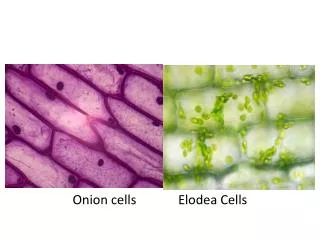
Eukaryotic Cells • Have a true nucleus • Size: 10-100+ microns • Include plants, animals, fungi and protista
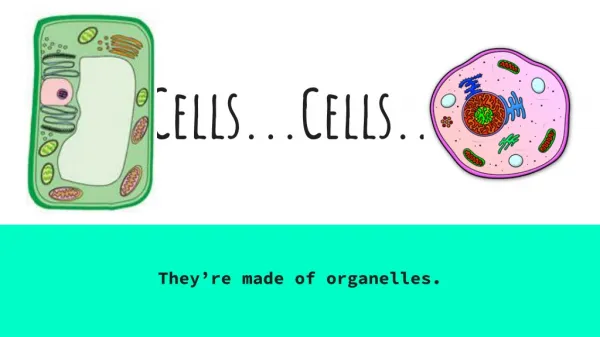
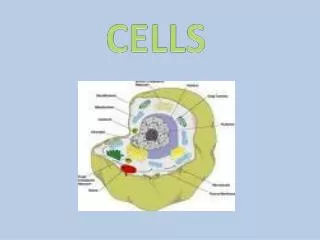
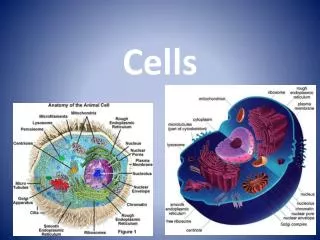
Basic Cell Design • Cell Membrane – surrounds the cell • Cytosol – “cell liquid” • Organelles – “little organs” • Nucleus- control center
Cell Membrane • Regulates the passage into and out of the cell • Provides protection • Helps in cellular recognition of molecules
Cytosol/Cytoplasm • Cytosol: the liquid portion inside the cell membrane • Cytoplasm: the cytosol and organelles, but not the nucleus
Nucleus • Contains DNA • The cell’s “brain” or CPU • DNA codes for protein production • Surrounded by the nuclear envelope
Cytoplasm • Contains the cytosol and organelles
Organelles • Ribosomes • Endoplasmic reticulum • Golgi bodies or complex • Lysosomes • Mitochondria • Chloroplasts
Ribosomes • Are the cell’s protein factories • Read mRNA code as seen on the right • Maybe free in the cytoplasm • Or bound to the ER
Endoplasmic Reticulum • Comes from the Greek Endo = “within”Latin reticulum = “network.” • A membrane network within the cytoplasm • Two types: Rough – with ribosomes attached (RER) • Or Smooth – with no ribosomes (SER)
Rough ER • Helps the ribosomes in the formation of proteins • Used to transport proteins to other parts of the cell
Smooth ER • Functions include synthesis of membrane lipids & detoxification of drugs • Liver cells contain large amounts of smooth ER
Golgi Body • Modify, sort, and package proteins from the ER for storage in the cell & secretion out of the cell
Lysosomes • Digestive sacs filled with enzymes • Breakdown lipids, carbohydrates, and proteins into a form that can be used by the cell • Digest worn out organelles
Helps to recycle cellular structures • Sometimes called “suicide sacs” • Involved in rheumatoid arthritis • Example…
Converts chemical energy stored in food into compounds that the cell can use (cellular respiration) • Contain their own DNA
Site of photosynthesis • Contains the green pigment chlorophyll • Helps to convert light energy, water, and carbon dioxide into sugars • Also contain genetic information
Endosymbiotic Theory • States mitochondria and chloroplasts were once free living prokaryotic cells • First proposed in the 1890s, but not supported until 1981 with the discovery of mitochondrial DNA • Explanation…
Vacuole • Storage area for water, salts, proteins, and carbohydrates • Many plants have a large central vacuole filled with liquid to support the plant
Cell Wall • The cell wall is a rigid structure that is found in plants, fungi, and bacteria cells • It supports and maintains the shape of the cell. It is extremely strong.