### Understanding Independent and Subordinate Clauses in Sentences ###
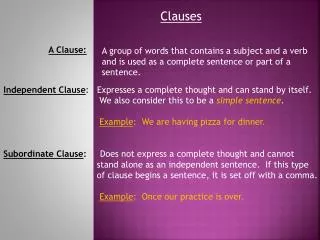
This guide covers the fundamental concepts of independent and subordinate clauses within sentences. An independent clause contains a subject and a verb, expressing a complete thought, while a subordinate (or dependent) clause, although having a subject and a verb, does not convey a complete thought. Examples illustrate the difference between the two types of clauses. Additionally, it highlights adverbial and adjectival clauses and their unique features, including the role of subordinating conjunctions and relative pronouns. ###

### Understanding Independent and Subordinate Clauses in Sentences ###
E N D
Presentation Transcript
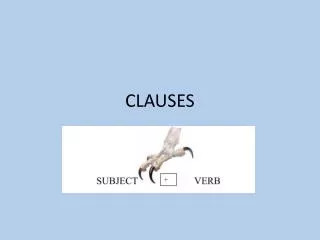
YEA! SANTA! Clauses Group of words Part of a sentence Has a subject and verb
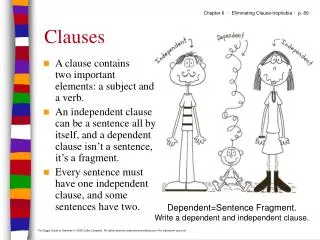
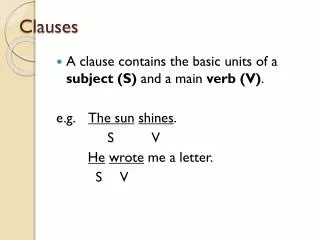
Independent clauses A sentence is an independent clause. An independent clause is a sentence. Iwill write with you, and you can analyze my handwriting. • Has a subject and a verb- I and will write • Can be a sentence- I will write with you.- That’s a complete thought.
Try it • My friend read a book, I jumped around the room. • Has a subject and a verb- friend-read • Can be a sentence- My friend read a book.
Subordinate/Dependent clause • subject and verb • but does not express a complete thought If I was sleeping I would have not gotten in trouble. • Has a subject and a verb- I - was sleeping • Can’t be a sentence- If I was sleeping-That’s not a complete thought!
Subordinating conjunctions • There’s a list on 645- copy it for the test. Once you have the list finding Adverbial Clauses is easier.
Adverbial clauses • Find a subordinate conjunction • Contains a subject and verb. • Finally, you will notice that the clause answers one of these three adverb questions:How?When? orWhy?
Check it, yo • Tommy scrubbed the bathroom tile until his arms ached. • Find a subordinate conjunction - UNTIL • Contains a subject and verb. ARMS ACHED • Finally, you will notice that the clause answers one of these three adverb questions:How?When? or Why? HOW
Josephine's three cats bolted from the driveway because they saw her car turn the corner. • Find a subordinate conjunction - BECAUSE • Contains a subject and verb. THEY SAW • Finally, you will notice that the clause answers one of these three adverb questions:How?When? or Why? WHY
After her appointment at the orthodontist, Danielle cooked eggs for dinner because she could easily chew an omelet. • Find a subordinate conjunction - • Contains a subject and verb. • Finally, you will notice that the clause answers one of these three adverb questions:How?When? or Why?
Relative Pronouns • Who • Whom • Whose • Which • That WRITE THIS DOWN!
Adjectival Clauses • Usually begin with a relative pronoun • Contains subject and verb • Answers adjective questions: What kind?How many? or Which one?