Human Growth and Development
This agenda focuses on child growth and development through effective discipline strategies. It emphasizes that discipline should teach self-control while nurturing the child. Various methods to address misbehavior are discussed, including communication, consistency, and positive reinforcement. The agenda also covers measures of central tendency in child development assessments, such as mean, median, and mode. Additionally, it provides insights into learning disabilities and the importance of understanding a child's unique learning needs.

Human Growth and Development
E N D
Presentation Transcript
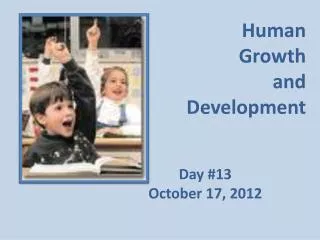
Human Growth and Development Day #13 October 17, 2012
Agenda – Day 13 • Sample Children’s Book Review • Discipline • Measures of Central Tendency • Begin “Fat City”
Discipline • Discipline is to teach a child how to learn self control, to recognize the acceptable limits of behavior, to know the boundaries of where to stop. • A child does not need to put under harsh treatment or put him down, but he needs to be corrected, trained and nurtured. • http://www.kinderpillar.com/blog/?p=259
When a child misbehaves:•STOP……….Ask yourself, “What is happening and Why is it happening?”•LOOK………Ask yourself, “What can I do about it?”•LISTEN…….Ask yourself, “How can I prevent it from happening again?”
Discipline • What method is best? • For infants? • For toddlers? • For preschoolers? • Name some pro’s and con’s of physical (corporal) punishment
Techniques to promote Self Discipline in pre school children • Set limits with rules- • Communication- • Positive reinforcement- • Be consistent- • Be fair- • Be firm- • Rewards- • Discipline on the spot- • Use timeout-
Don’ts- • Do not use any kind of physical punishment • Do not yell – talk to the child and explain why he or she should or should not do certain things. • Parents should be in agreement about discipline or not be in disagreement in front of the child. • Don’t severely criticize the child for the mistake that was made.
Don’t use language or actions to berate the child, cutting them down by hurtful words. • Don’t place blame for the improper actions. Condemning them to carry the guilt of the situation. • Don’t scold intensely with the purpose of humiliating the child.
Measures of Average • Mean – arithmetic average • Sum of all scores divided by the total number of scores • Median – midpoint in the distribution • Half of the scores fall above it and half fall below it • Mode – most frequently occurring score in the distribution
Bimodal distribution Skewed distribution
Calculating Growth and Development • Percentiles • Percentile rank – as if baseline were points from 1 – 100. Where would a particular score rank in relation to all other scores? • http://pediatrics.about.com/cs/growthcharts2/a/percentiles.htm
I.Q. Normal Curve Percentile rank – as if baseline were points from 1 – 100. Where would a particular score rank in relation to all other scores?
Intelligence • Intelligence Quotient (IQ) is the ratio of mental age to chronological age MA ------ x 100 = IQ CA (multiplied by 100 to make it a whole number rather than a fraction) • Usually, IQ is measured by a score on an intelligence test (score = mental age)
Introduction to Learning Disabilities A learning disability, or learning disorder, is not a problem with intelligence. Learning disorders are caused by a difference in the brain that affects how information is received, processed, or communicated.
FAT City WorkshopRichard Lavoie A child with a learning disability cannot try harder, pay closer attention, or improve motivation on their own; they need help to learn how to do those things.
Assignment • Test #2 due 10/22 • Begin Chapter 7 - 8 Middle Childhood – Grade School Years • Book Reviews – Wednesday 10/24