Understanding Key Concepts and Terms in Hinduism
160 likes | 274 Vues
Explore the foundational concepts of Hinduism, including Ahimsa, Atman, and Brahman, which guide the spiritual and ethical framework of this ancient religion. Learn about the significance of the Bhagavad-Gita and the Vedas, involving core teachings on duty (Dharma), the caste system, and the laws of Karma. Delve into essential practices such as Yoga and the philosophy of Moksha. Understand the role of Gurus in imparting wisdom and the belief in Reincarnation. Engage with Hinduism's deep-rooted history and its contemporary relevance to over a billion followers worldwide.


Understanding Key Concepts and Terms in Hinduism
E N D
Presentation Transcript
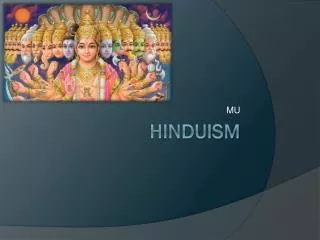
MU Hinduism
Terms • Ahimsa – the principal of non-injury to living things • Atman – the individual self, known after enlightenment to be identical with Brahman • Bhagavad-Gita – a portion of the Mahabharta, having the form of a dialogue between the hero Arjuna and his charioteer, the avatar Krishna, in which a doctrine combining Brahmanical and other elements is evolved.
Terms (cont.) • Brahman – the impersonal supreme being, the primal source and ultimate goal of all beings, with which atman, when enlightened, knows itself to be identical. • Caste system – a social structure in which classes are determined by heredity. • Dharma – essential quality or character, as of the cosmos or one’s own nature. • Guru – a preceptor giving personal religious instruction.
Terms (cont.) • Karma – action, seen as bringing upon oneself inevitable results, good or bad, either in this life or in a reincarnation. • Moksha – freedom form the differentiated, temporal, and mortal world of ordinary experience, • Reincarnation – the belief that the soul, upon death of the body, comes back to earth in another body or form.
Terms (cont.) • Upanishads – any of a closs of speculative prose treaties composed between the 8th and 6th centuries B.C. and first written A.D. c1300: they represent a philosophical development beyond the Vedas, having as their principal message the unity of Brahman and Atman.
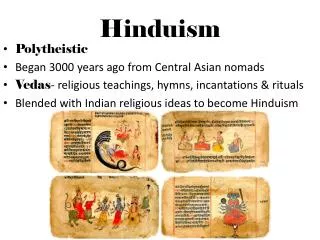
Terms (cont.) • Vedas – the entire body of Hindu sacred writings, chief among which are four books, the Rig-Veda, the Sama-Veda, the Atharva-Veda, and the Yajar-Veda. • Yoga – a school of Hindu philosophy advocationg and prescribing a course of physical and mental disciplines for attaining liberation from the material world and union of the self with the Surpreme Being or ultimate principle.
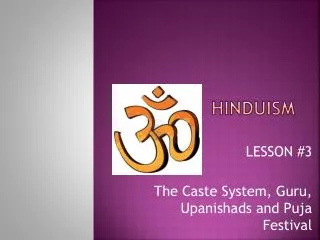
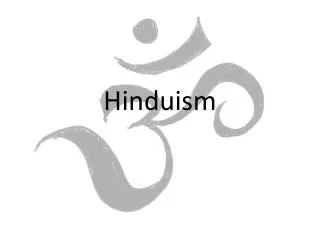
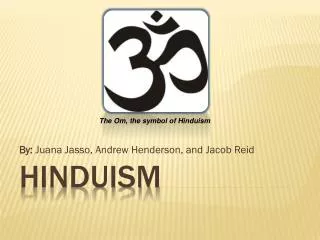
Symbols • Aum – symbolize the beginning, duration, and dissolution of the universe and the associated gods • Swastika - symbolize the suns rays which life depends on
World Map • Over 1,000,000,000 followers today
Clergy • Guru – “teacher” that passes knowledge to his students • Many other leaders • Yogins, Swamis, Pandits, Acharyas, Sadhus and Rishis
History • Oldest religion dating back to 5000 B.C. • 3rd most populous religion in the world • 762 mil. followers • Commonly misunderstood by non-followers • True name is Sanatana Dharma, meaning “the eternal religion” • They believe one cannot be ‘converted’ into Hinduism because it is a way of life, not a choice
Verdic Texts • The Rigveda: hymns (for the chief priest to recite) • The Yajurveda: formulas (for the priest to recite) • The Samaveda: formulas (for the priest to chant) • The Atharvaveda: collection of stories, spells, and charms
Hinduism in the news • Judge says yoga does not promote Hinduism in California school – July 2, 2013 • UK Hindus and caste – August 2, 2013
Review questions • What is it called when a Hindu reaches enlightenment? Moksha • What is the social system in Hinduism called? Caste System • What is the Hindu practice of training the consciousness called? Yoga • What is the 6th book of Mahabharata called?BhagavadGita • What is a spiritual leader in Hinduism called? Guru
Review questions (cont.) • What is the name for Hindus social duty and religious law? Dharma • What is the name of the ONE god in Hinduism? Brahman • What is the rebirth of the soul in another body? Reincarnation • What are good and bad acts that determine the quality of the next life in Hinduism? Karma • Basically the holy scriptures of Hinduism are called what? Vedas
Bibliography • http://myfantasticindia.com/hinduism-made-really-simple/ • http://en.wikibooks.org/wiki/Hinduism/Religious_Symbols_of_Hinduism • http://www.patheos.com/Library/Hinduism/Ethics-Morality-Community/LeadershipClergy.html • http://www.theguardian.com/world/2013/jul/02/judge-yoga-promote-hinduism-californian-schools • http://www.gwu.edu/~satyam/history.htm