Civil War
This overview explores the pivotal moments of the Civil War, beginning with Abraham Lincoln’s election in 1860, where he garnered 39% of the popular vote but received no electoral votes from the South, resulting in Southern secession. Key events such as the attack on Fort Sumter, the Battle of Bull Run, and the significance of the Emancipation Proclamation are highlighted. The narrative culminates with the Union victory at Gettysburg and Lee’s surrender to Grant at Appomattox, along with the assassination of Lincoln, marking the end of a transformative period in U.S. history.

Civil War
E N D
Presentation Transcript
Civil War United States History Mrs. O’Shea
1860 Presidential Election Abraham Lincoln won • 39% popular vote • 180 electoral votes • not a single electoral vote from South • Name did not appear on many southern ballots
Southern Secession • South Carolina seceded in Dec. 1860 • 6 others states followed = Texas Louisiana Mississippi Alabama Florida Georgia • Created Confederate States of America
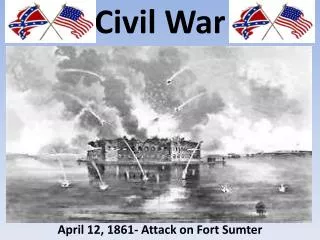
Fort Sumter • Federal fort outside Charleston, SC • Federal supply ship shot at by Confederates • Lincoln wanted to preserve Union – must protect fort • April 12, 1861 – Confederates seize fort
Review • Lincoln elected President - 1860 • Southern states secede • Fort Sumter – beginning of war • North – Preserve the Union • South – Federal government no longer represents our interests. We voluntarily joined United States, we choose to leave it.
Battle of Bull Run • Union troops – not prepared • Sent by Lincoln to capture Richmond – Confederate capital city • Met with 32,000 Confederate troops outside of Manassas. • Union troops were sent running back to Washington, D.C. IMPORTANCE • Boosted Confederates morale • Signaled to Union that they needed to prepare for a real war
CASUALTIES • Heavy casualties on both sides – killed, wounded, captured, or MIA • Disease (typhoid fever, dysentery, salmonella, gangrene, malaria)
Casualties (deaths) Revolutionary War = 4,400 Mexican American War = 13,000 Civil War = 600,000 WWI = 115,000 WWII = 407,000 Korean War = 33,000 Vietnam War = 58,000 War in Iraq = 4,244(as of February 13, 2009) Really rough estimates – Mrs. O’Shea
Lincoln and Slavery • “Preserve the Union” • Personally opposed to slavery • Came to regard abolishing slavery as a strategy for winning war • Slave working in field = one more Southerner fighting in fields
Emancipation Proclamation p. 396 Who was freed? slaves under Confederate control Some Northerners feared … freed people would increase unemployment Abolitionists criticized Lincoln for … not going far enough by freeing all slaves Southerners … condemned it
African Americans in War • July 1862 – Congress allows African-Americans to join military • January 1, 1863 – Emancipation Proclamation – encouraged freed slaves to fight • By 1865 – 180,000 African Americans had enlisted (10% of troops) • Less pay • Black regiments – white officers • 54th Massachusetts Infantry – bravery in attack on Ft. Wagner – first medal of honor (Sergeant William Carney) GLORY
Plans to Win!!! • Union – attacked from West and East – Anaconda Plan (choke them) • Confederacy – attacked Union through Virginia (scare Northerners – fuel anti-war movement in North)
Gettysburg • 3 days – July 1-3, 1863 • Greatest battle ever fought in North America • Bloodiest battle of war Union = 23,000 casualties Confederacy = 28,000 casualties IMPORTANCE • Union victory ended Lee’s invasion of North • Referred to as “turning point of war”
Gettysburg Address • Dedication of cemetery • Honors Union soldiers • Expresses grief of nation • Necessity of preserving the Union http://www.npr.org/templates/story/story.php?storyId=1512410
“War is cruelty. The crueler it is, the sooner it will be over.”
Sherman’s March p. 412 • Union General William Sherman’s total war • GOAL = destroy the Confederacy's ability to wage further war • 300 mile path of destruction – destroying railroads, bridges, factories, livestock, crops, etc. • Most likely speed up the ending of the war
South Surrenders Lee surrenders to Grant at Appomattox Court House, Virginia (private home – not a court building) -take horses and go home -obey laws April 9, 1965
Lincoln Assassinated • April 14, 1865 • John Wilkes Booth – wanted to kidnap in exchange for Confederate prisoners. • Changed plans – killed Lincoln • Ford’s Theater