Download
1 / 21
210 likes | 339 Vues
This examination delves into Woodrow Wilson's aspiration to "make the world safe for democracy" in the context of World War I. The quote encapsulates U.S. foreign policy ideals as the nation shifted from isolationism to intervention after factors like the sinking of the Lusitania and the Zimmermann Telegram. The Great War, which began in 1914 and resulted in over 37 million casualties, revealed the complexities of great power politics, militarism, and nationalism. This exploration illustrates how Wilson's vision shaped America's role on the global stage.

E N D
The Great War Explosion
Focus Question: • Explain how the following quote corresponds with U.S. foreign policy ideas: “To make the world safe for democracy” -- Woodrow Wilson, April 1917
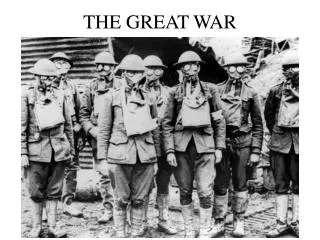
EXPLOSION • The world erupted into war in August 1914 • Led to more than 37 million casualties • Decimated a generation in Europe
Great Power Politics • The World dominated by the Great Powers • Great Powers: Nations capable of defeating any one other nation Austria-Hungary Britain France Germany Italy Russia United States Jockeying for supremacy likely
Assassination of Archduke Ferdinand • War was set off with the assassination of Franz Ferdinand on June 28, 1914. • Heir to the throne of Austria-Hungary • Shot in Sarajevo, Bosnia-Herzegovina • Killed by a Serbian nationalist • Catalyst of the War
Militarism • Trust in the military • Glorify military glory • Promoted an arms race to “prove supremacy” • More troops, more guns, more ships • Pushed rivals to develop more troops, more ships, more guns
Imperialism • Available territories had dried up • Need for new territories did not • Desire for the territories of other nations • Equality of power
Nationalism • Intense devotion to one’s country fostered • Desire of Great Powers to dominate • Desire for small nations to gain independence • Destablilized the situation
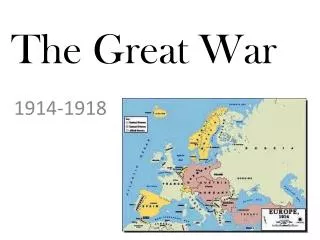
Entangling Alliances • Defensive alliances • If another attacked an ally, the others were to help • Europe divided into two armed camps • Triple Alliance • Triple Entente • Smaller nations tied to Great Powers
War! • World War 1 (the Great War) -- July 28, 1914 • Snowballed into tragedy • Europe torn between the Allies and the Central Powers
Stalemate! • The Great War bogged into stalemate • Russian numbers too great in the East • Trench warfare in the West • Casualties mounted
Neutrality • Initial intent was to remain neutral • U.S. interests were not at risk • U.S. public opinion torn • Isolationist tendencies • U.S. militarily unprepared • Wilson as a peacemaker
However . . . • U.S. drawn toward the Allies • German violation of neutral rights (Belgium) • Trade imbalance • American bank loans to the Allies • German U-Boat campaign
U-Boat Campaign • World War I saw the first mass use of submarines (Unterseeboot) • Germany targeted military and supply ships
U.S. Opinion inflamed • Civilians killed when passenger liners attached • Lusitania • Sussex • Wilson threatened to cut ties with Germany • Sussex Pledge (May 1916) • Germany agreed to stop targeting certain ships
Preparations • Influential Americans proposed entering the war in 1915 • National Defense Act passed in June, 1916 • Saw a rapid growth of the military • Increased Army to 175,000 troops • 50 new warships for the Navy
1916 Presidential Campaign • Seen as a referendum on U.S. policy • Wilson promoted Progressive causes • Anti-War Sentiments strong • “He Kept Us Out of the War”
U.S. Declares War – April 1917 • Zimmermann Telegram • Germany to start “unrestricted submarine warfare” in February 1917 • Germany attempts alliance with Mexico • Plan was for Mexico to declare war on the U.S. • U.S. Merchant ships sunk by U-boats • Spectre of U.S. economicdifficulties
Not a Bang, but a Whimper • The War ended on November 11, 1918 • German troops simply gave up • Could not match numbers of the Allies • Allied troops did not set foot in Germany during the War