Understanding Hinduism: Origins, Key Concepts, and Divisions
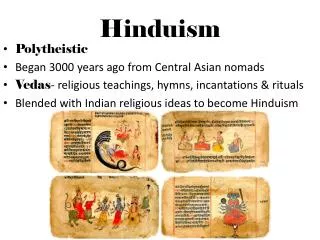
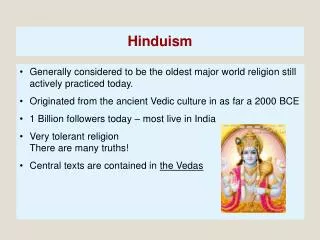
Hinduism, originating in India with the Aryan invaders, is predominantly practiced in South and East Asia. The faith lacks centralized texts but uses the Vedas and Upanishads for spiritual guidance, which detail universe origins and prayers. Central to Hindu belief are concepts like karma, dharma, and moksha, aiming for spiritual liberation. The religion reveres three main deities: Brahma (the creator), Vishnu (the preserver), and Shiva (the destroyer), reflecting its core belief in one supreme force, Brahma, with diverse expressions. The role of women and distinct divisions like the worshippers of Vishnu contribute to its complexity.

Understanding Hinduism: Origins, Key Concepts, and Divisions
E N D
Presentation Transcript
Hinduism By: Amanda, Haylee, Houston, and McKenzie
Main Facts • Hinduism began in India with the Aryan invaders, but no one knew exactly how it began. It was mainly worshipped in south and east Asia. Though there were no centralized texts, the Vedas and the Upanishads were used for prayers, verses, and descriptions of the origins of the universe to guide the Hindus. Hinduism always have to have the seven main forces
Main Facts Continued • The concepts of karma (your actions in the past life determine the role you are born into in a future life) and dharma (the rules and obligations of the caste you’re born into) held their views of death and the afterlife. They strived to achieve moksha, the highest state of being, one of perfect internal peace and release of the soul. The main dieties are Brahma the creator, Vishnu the preserver, and Shiva the destroyer. Atman is the immortal aspect of the moral existence, the self, which is hidden in every object of creation including man. They believed in one supreme force (Brahma), and that their gods are manifestations of Brahma. Their life goal is to merge with Brahma by achieving moksha.
Main Divisions Four main divisions worshipers of vishnu `