HINDUISM
180 likes | 288 Vues
Hinduism, a complex and ancient religion, lacks a single founder and has evolved over thousands of years, primarily through the Vedic scriptures. Central to its beliefs are the concepts of Brahman (the supreme being) and the cycle of Samsara (birth, death, and rebirth), with the ultimate goal of attaining Moksha (liberation). The caste system, consisting of four main social classes, influences societal structure. Key deities include Brahma, Vishnu, and Shiva. Hindu practices emphasize non-violence, meditation, and rituals, with significant celebration during festivals like Diwali.


HINDUISM
E N D
Presentation Transcript
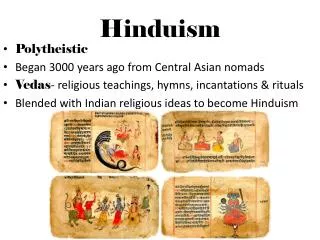
Founding of the Religion • No single founder • Made from a beliefs collected over thousands of years. • Vedic scriptures (Vedas): considered revealed knowledge, “that which is heard” • In these scriptures are information on origins of God, the presence of the atman, meditation, praying, hymns, and religious rituals.
The Caste System • Socio-religious hierarchy called varna or caste • Four castes (social classes) • 1. Brahman = priests • 2. Kshatriya = warriors, leaders, and administrators • 3. Vaishya = merchants, traders, farmers, and craftsmen • 4. Shudra = servants
Untouchables = a lower category besides those in the caste system
One supreme being (Brahman) in various forms that relate to the different functions served as a God. • Omnipresent- always present everywhere and in all living things. • Can be represented in a male or female form
3 Main Deities (Trinity) • 1) Brahma- creator of the universe, what all living things evolved from • 2) Vishnu- preserver of the universe, protects the world from evil, and represents mercy and goodness. • 3) Shiva- destruction and reproductive power.
Wheel of Samsara • Cycle of birth, death, and rebirth • Soul= atman • Goal is to live a life so the atman can be released from Samsara and reach the state of maksha (when the atman is united with God) • Do this by keeping good karma (thoughts and actions have results that correspond to them) and fulfilling their dharma (duties)
Four Goals • Moksha- liberations, feedom • Dharma- duty (responsible acceptance of one’s social station and its results) • Artha- wealth • Kama- pleasures of all kinds
Ahisma • No injury to any life form • So no violence and they are vegetarians
Prayer= State of meditation, Yoga • can worship at a mandir (temple) or at their own shine inside their home to whatever deity they find most important in their life.
Cows • they are to be treated with the same respect 'as one's mother' because of the milk they provide • Bulls in particular are seen as a symbolic emblem of selfless duty and religion
Divali • Festival of lights • To celebrate the Hindu new year (during October/November • Time to start again • Try to fix arguments, put aside differences