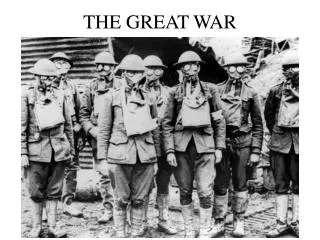
The Great War
Explore the key factors leading to the outbreak of World War I, including militarism, alliances, nationalism, and imperialism. Learn how the assassination of Archduke Franz Ferdinand ignited tensions among European powers, directly leading to war. This video also examines the reasons for U.S. involvement, such as the sinking of American ships, the Zimmerman Telegram, and the need to support Allied nations. Discover how America mobilized its military and industries to support the war effort, transforming society and the economy.

The Great War
E N D
Presentation Transcript
The Great War 1914-1918http://www.youtube.com/watch?v=i2CgUIrBHoo
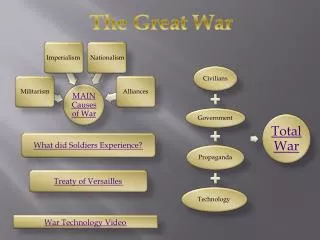
Outbreak of WWI Long term causes for the outbreak of World War I • Militarism • The belief that a nation needs a large military force • Alliances • Agreement between countries • Nationalism • The feeling of pride, loyalty, and protectiveness of one’s country • Imperialism • The policy by which stronger nations extend their economic, political, or military control over a weaker nation.
Outbreak of War Immediate cause of the outbreak of WWI • Assassination • Archduke Franz Ferdinand and his wife were murdered in Sarajevo June 28, 1914 • Austria-Hungary declared war on Serbia; soon after other European countries were following (because of alliances)—leading to the outbreak of WWI • http://www.youtube.com/watch?v=kfxrTD-kPps
Reasons for U.S. involvement in War • Inability to remain neutral • Sinking of American merchant ships • Alliance with Great Britain • German submarine warfare • German u-boats torpedoed several merchant ships without warning—unrestricted warfare. • Sinking of the Lusitania • Germany torpedoed the British passenger ship killing 1,198 people including 128 Americans • U.S. economic and political ties to Great Britain • The Zimmerman Telegram
World War I:The United States enters the war The Untied States Declares War Wilson is reelected in 1916 and events quickly turned the US towards war. Zimmerman Telegram: • German official named Arthur Zimmerman, instructed the German ambassador to propose an ally between Mexico and Germany. • Germany wanted the US forces to be tied down to Mexico, not Europe. • Plan fails when British intelligence intercepts the Zimmerman Telegram. • In March 1917, Germany continues with unrestricted submarine warfare; sinking three American ships. • Wilsonasks for a declaration of War, April 6, 1917 http://www.youtube.com/watch?v=TBjSeQ602ZI
The Home Front Step 1: Building up the Military • Selected Service • All men between the ages of 21-30were required to register for the draft and a lottery randomly determined the order they were called. • 2.8 million men were drafted and 2 million volunteered. • African Americans • 400,000 were drafted only 42,000 served in combat. • Encountered discrimination and prejudice in combat. • Served in segregatedunits.
HOMEFRONT Step 2: Organizing Industry • Congress creates special boards to coordinate mobilization of economy. • Used to emphasize cooperation between big businesses and government
HOMEFRONT • Food & Fuel • Food Administration; Herbert Hoover • To conserve food Americans followed: • WheatlessMonday’s, Meatless Tuesdays, Porkless Thursdays • Victory gardens • Fuel ; Harry Garfield • Introduced daylight savings to conserve energy. • Heatless Mondays • Shortened work weeks for non war production factories. • Paying for War • Bonds: American people were loaning the government money. • Victorybonds
HOMEFRONT Step 3: Mobilizing for War • National War Labor Board • Mediate labordisputes. • Pressured industry to grant wage increases, 8 hour workdays, right of unions • Women’s Support Industry • Filled vacancies in the industry. • Shipping industries • Railroad industries • Jobs were not permanent for women.
Women • First time served in armed forces as • Nurses, clerical duties, radio operators, electricians, pharmacists, photographers, chemists and torpedo assemblers • 11,000 women served in Navy • Army only allowed to enlist in Army Nursing Corps: 20,000 served and 10,000 served overseas http://www.youtube.com/watch?v=lOLlDSbe4y8